
Executive Privacy Risks: When Leaders Should Consider a Bug Sweep
Executives should consider a professional bug sweep when sensitive conversations, strategic information, or private activities face credible surveillance risks at offices, homes, hotels, vehicles, or temporary meeting locations. A TSCM assessment can help identify unauthorized technical surveillance and security vulnerabilities before confidential information is compromised.
Senior leaders often handle negotiations, financial plans, legal strategy, personnel decisions, and intellectual property. That information can attract unwanted attention. A professional privacy strategy combines technical inspections with access controls, secure communications, travel precautions, and periodic reassessment based on changing threats, environments, and business activities.
Why Do Executives Face Higher Privacy and Surveillance Risks?
Executives routinely possess information that can have significant financial, competitive, legal, or reputational value.
Strategic plans, acquisition discussions, contract negotiations, pricing decisions, intellectual property, litigation strategy, and personnel matters may all create incentives for unauthorized information gathering.
Leadership roles also increase visibility.
Executives often attend public events, travel frequently, meet external parties, and work across several locations. Each additional environment can introduce people, equipment, and access conditions outside the organization’s direct control.
Risk does not mean surveillance is occurring.
A high-profile position alone is not evidence that someone is being monitored. The purpose of executive security planning is to assess exposure realistically and apply protections that match the circumstances.
Threats can also come through several channels. Physical surveillance, technical monitoring, compromised communications, unauthorized access, and careless information handling can create different vulnerabilities.
TSCM addresses technical surveillance concerns. It works best as one part of a broader executive privacy program that also considers physical, digital, and procedural security.
Which Office Environments Create the Most Exposure?
Office environments create greater exposure when sensitive conversations occur in spaces with broad or poorly documented access.
Executive offices and boardrooms are obvious priorities, but conference rooms, legal meeting areas, shared workspaces, and temporary offices can also require attention.
Access history matters.
A room regularly entered by contractors, cleaning personnel, maintenance teams, technology vendors, visitors, and outside consultants has a different risk profile from a tightly controlled executive suite.
Renovations and equipment changes can create additional uncertainty.
New audiovisual systems, conferencing equipment, furniture, networking hardware, electrical work, and building upgrades can introduce devices or access events that should be documented.
Shared facilities deserve particular consideration. Businesses may have less control over conference centers, coworking spaces, leased meeting rooms, or offices managed by another organization.
Executives should know where their most sensitive discussions occur and who can enter those environments.
Privacy protection becomes more effective when access controls, equipment inventories, visitor procedures, and TSCM assessments are focused on locations where disclosure would create the greatest consequences.
How Can Business Travel Increase Privacy Risks?
Business travel places executives in environments where they have less control over rooms, devices, networks, and physical access.
Hotels, rented offices, conference venues, private meeting rooms, vehicles, and temporary workspaces may be used by many people before and after an executive arrives.
Travel also concentrates valuable information.
Negotiations, investor discussions, legal matters, acquisition plans, and other confidential conversations may occur during trips because key participants are gathered in one location.
Executives should avoid assuming that every unfamiliar environment is compromised. Instead, travel security should reflect the sensitivity of the business activity and any credible threat information.
Practical precautions include limiting confidential conversations in uncontrolled spaces, protecting devices, using approved communications methods, and understanding who can access meeting locations.
For particularly sensitive travel, advance security planning may include professional assessment of selected environments.
TSCM can address technical surveillance risks, but it should complement cybersecurity, physical security, secure transportation, and disciplined information handling throughout the trip.
Are Executive Homes Vulnerable to Unauthorized Monitoring?
Executive residences can face privacy concerns because business and personal activities increasingly overlap.
Leaders may conduct calls, review confidential documents, participate in virtual meetings, and discuss company matters from home. That can make residential privacy relevant to corporate security.
Homes also contain numerous connected devices.
Smart televisions, speakers, cameras, security systems, wireless networks, assistants, appliances, and home automation products create a complex electronic environment. Most are legitimate, but poor configuration or unauthorized changes can introduce vulnerabilities.
Residential access is another consideration.
Household employees, contractors, service providers, guests, property managers, and maintenance personnel may enter the home at different times.
A bug sweep may be appropriate when there is a credible surveillance concern, unexplained disclosure of conversations held only at the residence, suspicious equipment, or another significant risk indicator.
Residential assessments require discretion because family privacy is involved.
The scope should focus on legitimate security concerns while respecting household members, personal spaces, applicable laws, and the difference between ordinary connected technology and actual unauthorized surveillance.
What Are the Signs of Possible Targeted Surveillance?
Possible warning signs should be evaluated collectively rather than treated as automatic proof of surveillance.
Repeated disclosure of confidential information can deserve attention, especially when the information was discussed verbally with a very limited group.
Unfamiliar devices or unexplained physical changes may also raise questions.
An executive or security team might notice altered fixtures, unexpected cables, unknown adapters, unusual electronic components, displaced ceiling panels, or equipment that authorized personnel cannot identify.
Unusual access events can matter as well.
Unauthorized entry, unexplained contractor access, a break-in, tampering, or unexpected changes after maintenance may justify additional review.
Electronic interference alone is weak evidence. Wireless congestion, faulty equipment, network problems, legitimate transmitters, and ordinary technical failures can produce strange behavior.
Document patterns instead of assuming a cause.
Record when the concern appeared, where it occurred, who had access, and what confidential information may have been affected.
A professional assessment can then evaluate whether the circumstances support technical surveillance concerns or point toward another security issue.
When Should an Executive Consider a Professional Bug Sweep?
A professional bug sweep should be considered when credible circumstances create concern about unauthorized technical surveillance.
One trigger may be an unexplained information leak involving discussions held in a controlled environment.
Another may be suspicious physical changes, unfamiliar electronic equipment, unauthorized access, or tampering in an executive office, boardroom, residence, vehicle, or other sensitive space.
High-risk business events can also justify preventive assessment.
Major transactions, mergers, acquisitions, litigation strategy sessions, sensitive negotiations, product launches, leadership changes, and confidential board meetings may increase the value of information being discussed.
Timing should be based on risk.
Some assessments are reactive and occur after suspicious activity. Others are preventive and take place before particularly sensitive events.
Executives should avoid broadly announcing a planned inspection when there is a genuine surveillance concern.
A discreet consultation can help define the threat, prioritize locations, and determine whether a full TSCM assessment is appropriate rather than conducting unnecessary inspections based solely on anxiety or speculation.
What Can a TSCM Sweep Detect?
A professional TSCM sweep can identify certain technical surveillance devices, suspicious electronic components, unusual radio-frequency activity, physical anomalies, and security vulnerabilities within the inspection scope.
The exact capabilities depend on the environment and methods used.
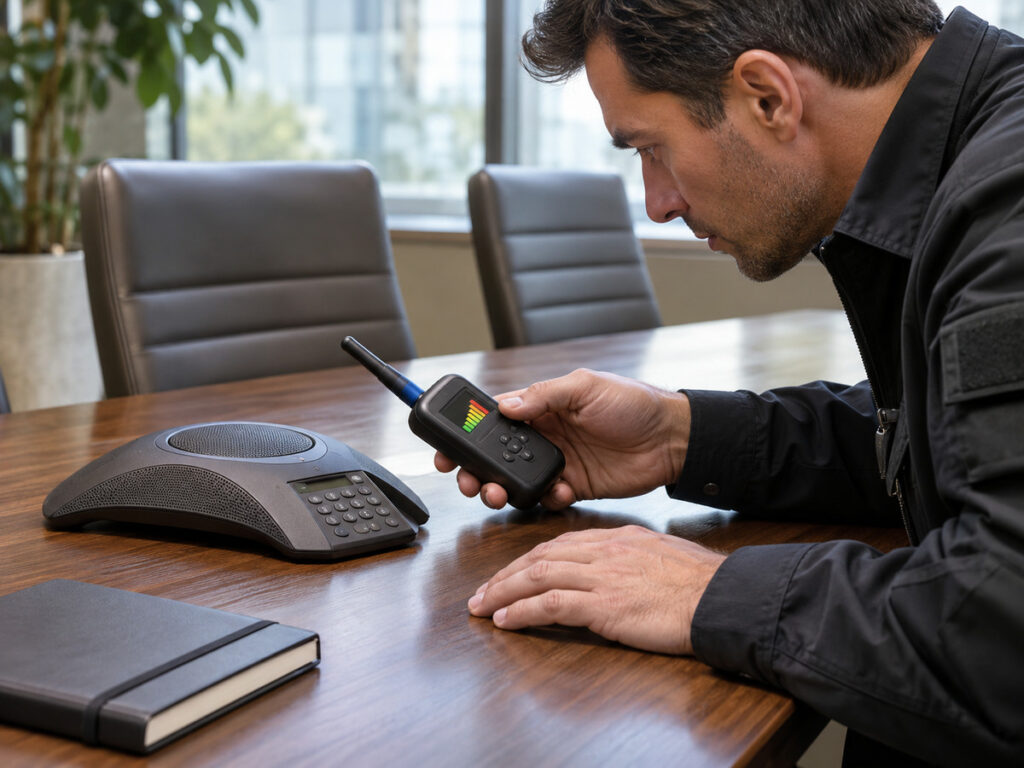
Radio-Frequency Activity
Specialized equipment can help evaluate wireless signals and determine whether unexplained transmissions deserve additional investigation.
Physical Surveillance Indicators
A detailed inspection may identify concealed devices, modified fixtures, suspicious wiring, unfamiliar components, or changes inconsistent with the expected environment.
Nontransmitting Electronics
Some professional techniques can assist in identifying electronic components even when they are not actively transmitting.
Infrastructure Concerns
Communications systems, audiovisual equipment, power sources, and other relevant infrastructure may receive attention depending on the threat assessment.
Detection requires interpretation.
Modern executive environments contain many legitimate electronic devices and signals. A professional must distinguish expected activity from anomalies.
TSCM therefore combines technical equipment, physical examination, contextual information, and investigative judgment rather than relying on a single detector or scanning method.
What Are the Limits of a Bug Sweep?
A professional bug sweep cannot guarantee that every possible surveillance method will be discovered under every circumstance.
Surveillance technology varies in design, placement, operation, and communication method. Some devices transmit continuously, while others operate intermittently or store information for later retrieval.
The environment can also change after an inspection.
New employees, visitors, contractors, renovations, equipment installations, travel, and unauthorized access can introduce new risks after a location has been assessed.
TSCM also does not replace cybersecurity.
A technically secure meeting room cannot protect information that leaves through compromised email accounts, stolen credentials, insecure networks, careless document handling, or authorized people who disclose confidential information.
The scope of an inspection matters.
Areas that were not accessible or included cannot reasonably be treated as cleared by the assessment.
Responsible providers explain these limitations rather than promising complete protection.
A TSCM sweep provides information about the conditions examined at a particular time. Ongoing security requires continued attention to access, technology, people, and changing threats.
How Can Leaders Build an Ongoing Privacy and Security Plan?
Executive privacy works best when physical, technical, digital, and procedural protections support each other.
Start by identifying which information and locations require the greatest protection.
Not every room or conversation carries the same risk. Prioritizing executive offices, boardrooms, residences used for business, and high-value meeting locations makes security resources more focused.
Control access carefully.
Organizations should know who enters sensitive spaces, why access is needed, and when contractors or vendors perform work. Equipment changes and maintenance should be documented.
Secure communication practices are equally important.
Executives should use organization-approved devices, networks, and communication methods rather than relying on convenience during sensitive discussions.
Travel procedures should address temporary offices, hotels, transportation, devices, and meeting locations.
TSCM can then be incorporated according to risk.
The strongest program is not based on constant suspicion. It establishes repeatable procedures for identifying unusual events, documenting concerns, assessing exposure, and escalating credible security issues to qualified professionals when necessary.
How Often Should High-Risk Environments Be Reassessed?
There is no universal schedule for executive TSCM assessments.
Frequency should reflect the organization’s threat profile, confidentiality needs, access patterns, business activities, and previous security concerns.
A high-risk executive environment may justify periodic reassessment, while another organization may use event-based inspections instead.
Significant changes can create natural review points.
Office renovations, new communications equipment, changes in executive personnel, contractor access, relocations, mergers, contentious disputes, or major transactions may alter the risk environment.
Travel and temporary locations require separate consideration because an earlier sweep of a permanent office says nothing about a hotel suite or rented meeting room.
Reassessment should also follow credible incidents.
Unexplained information leaks, suspicious devices, unauthorized access, or tampering can justify a new professional review regardless of the previous inspection date.
The goal is proportionality.
Organizations should match the frequency and scope of TSCM work to realistic exposure rather than treating frequent sweeps as a substitute for effective access control and broader security practices.
FAQs
Do all executives need regular bug sweeps?
No. The need depends on information sensitivity, threat exposure, access conditions, business activities, and credible security concerns. Some leaders may benefit from periodic assessments, while others may need TSCM only around specific events.
Can a bug sweep detect hidden cameras?
Professional TSCM assessments may include methods for identifying certain concealed cameras and associated electronic components. Detection depends on the device, placement, operating condition, environment, and inspection scope.
Should an executive home be swept before an office?
There is no universal priority. The location where the most sensitive conversations occur, combined with credible threat information and access history, should guide the decision.
Can TSCM protect confidential information during business travel?
TSCM can help assess selected physical environments for technical surveillance concerns. Travel security should also include secure communications, device protection, physical access controls, and careful handling of sensitive discussions and documents.
Does an information leak prove an office has been bugged?
No. Information can leak through employees, compromised accounts, insecure communications, shared documents, vendors, or other channels. A technical sweep can evaluate surveillance concerns while other investigative or cybersecurity work examines alternative explanations.
What should an executive do after discovering a suspicious device?
Avoid unnecessary handling or dismantling. Document the location and condition, restrict access when appropriate, and obtain professional guidance. Depending on the circumstances, corporate security, legal counsel, investigators, or law enforcement may need to become involved.
Key Takeaways
Executives face increased privacy exposure because valuable business information travels across offices, homes, vehicles, hotels, and temporary meeting spaces. A professional TSCM sweep can evaluate technical surveillance concerns by combining physical inspection, electronic analysis, and experienced interpretation. Leaders should consider an assessment when credible warning signs, sensitive events, unusual access, or significant confidentiality risks exist. TSCM cannot guarantee permanent protection or replace cybersecurity and access controls. An effective executive privacy plan combines appropriate sweeps with secure communications, controlled access, travel precautions, incident documentation, and risk-based reassessment as environments and threats change.
Protect Executive Conversations With a Risk-Based Privacy Strategy
Executive privacy should be managed according to actual exposure, not assumptions. At Whitesell Investigation Services, we approach TSCM assessments by first understanding the circumstances, identifying sensitive environments, and determining where focused technical and physical inspection can provide useful information.
We can help executives, businesses, and their advisors evaluate credible surveillance concerns and identify areas that may warrant professional assessment. Whether the concern involves an office, residence, travel environment, or upcoming confidential event, we can discuss the situation discreetly and determine whether a professional bug sweep fits the broader security plan.