
Signs Your Office May Need a Professional Bug Sweep
Signs your office may need a professional bug sweep include unexplained information leaks, unfamiliar devices, unexpected physical changes, unusual electronic activity, or concerns following sensitive meetings. A professional Technical Surveillance Countermeasures inspection can assess whether unauthorized surveillance equipment or related security risks may be present.
One unusual event does not automatically prove electronic surveillance. Businesses should document concerns, limit unnecessary discussion, and avoid disturbing suspicious items. A professional TSCM assessment provides a structured way to evaluate the environment, preserve potential evidence, and determine whether further investigative or legal action is appropriate.
What Are the Signs Your Office May Need a Bug Sweep?
A professional bug sweep may be appropriate when several unexplained events suggest that confidential conversations or information are reaching unauthorized people.
One possible warning sign is repeated disclosure of information known only to a limited group. Another is the discovery of unfamiliar equipment, wiring, adapters, chargers, or electronic components in sensitive areas.
Physical changes can also deserve attention. Employees might notice a ceiling tile, outlet, smoke detector, furniture item, or wall fixture that appears altered without an obvious maintenance explanation.
Context matters.
A single unusual device or information leak does not establish that surveillance is occurring. Ordinary equipment changes, cybersecurity problems, employee disclosures, poor access controls, or simple coincidences can create similar concerns.
Businesses should therefore avoid jumping to conclusions.
A professional TSCM inspection evaluates the physical and electronic environment systematically. The objective is to identify anomalies, investigate suspicious findings, and document relevant conditions without assuming beforehand that an unauthorized surveillance device will be discovered.
Can Unexplained Information Leaks Signal a Surveillance Concern?
Repeated leaks of confidential information can justify closer examination, particularly when the information was discussed verbally in a restricted office or meeting room.
Consider who legitimately knew the information before assuming surveillance occurred.
Employees, contractors, vendors, visitors, electronic communications, shared documents, compromised accounts, and weak internal controls can all create information leaks without a listening device being involved.
Patterns are more useful than isolated incidents.
If confidential negotiating positions repeatedly become known shortly after closed meetings, for example, management may have reason to examine both physical security and information security.
Document what happened, when the information was discussed, who attended, where the discussion occurred, and when the suspected disclosure became apparent.
Avoid openly accusing an employee or visitor without supporting evidence.
A TSCM sweep can address the technical and physical surveillance question. Other investigative or cybersecurity work may be necessary when the circumstances indicate that information could be leaving through people, networks, accounts, or business processes instead.
What Suspicious Devices or Physical Changes Should You Notice?
Unexpected objects or modifications can deserve professional review when they appear in areas where confidential conversations occur.
Examples may include unfamiliar power adapters, cables, USB devices, chargers, electronic components, small openings, displaced fixtures, or equipment that no employee recognizes.
Changes around outlets, ceiling panels, conference equipment, furniture, telephones, networking hardware, and other office infrastructure may also raise questions.
Do not assume that an unfamiliar item is a bug.
Modern offices contain many legitimate wireless devices, sensors, access-control components, building-management systems, audiovisual equipment, and network products. Maintenance teams or landlords may also install equipment without every employee knowing.
The appropriate response is observation and documentation rather than dismantling.
Record where the object or change was noticed and when it was first observed. Determine whether authorized facilities or technology personnel can explain it without unnecessarily disturbing the area.
If concerns remain, leave the item in place when safe to do so and contact a qualified professional who can assess it using appropriate investigative procedures.
When Do High-Risk Meetings Increase the Need for a Sweep?
Certain business activities involve information valuable enough to justify stronger protective measures.
Merger discussions, acquisitions, litigation strategy, intellectual property matters, executive decisions, sensitive personnel issues, financial negotiations, product development, and major contract discussions can create elevated confidentiality concerns.
A sweep may be considered before an important meeting when there is a credible security reason, or as part of a broader protective program for sensitive environments.
The decision should be based on risk rather than fear.
Ask who has access to the meeting area, what information will be discussed, whether outside visitors regularly use the space, and whether there have been previous confidentiality problems.
Temporary meeting locations can require additional consideration because the business may have less control over physical access and installed equipment.
TSCM should complement other security practices.
Access controls, secure document handling, cybersecurity measures, visitor procedures, employee awareness, and appropriate meeting protocols remain important even when a professional sweep finds no unauthorized surveillance equipment.
Can Unusual Electronic Interference Be Relevant?
Unusual electronic behavior can raise questions, but interference alone is not reliable proof that a surveillance device is present.
Businesses sometimes become concerned after hearing unexpected audio from speakers, experiencing telephone problems, noticing wireless disruptions, or seeing unfamiliar network activity.
Many ordinary technical issues can produce these symptoms.
Faulty equipment, electromagnetic interference, wireless congestion, damaged cables, software problems, nearby transmitters, and normal device behavior can all create electronic anomalies.
Avoid relying on consumer myths to determine whether an office is bugged. A telephone behaving strangely or a radio producing interference does not automatically indicate surveillance.
Document repeated events instead.
Note the location, time, equipment involved, duration, and circumstances. Technical staff may be able to eliminate common equipment problems before further investigation becomes necessary.
When unexplained electronic issues occur alongside information leaks, suspicious physical changes, or other credible concerns, a professional assessment may be appropriate.
TSCM specialists evaluate multiple indicators rather than treating one electronic symptom as conclusive evidence.
What Does a Professional TSCM Bug Sweep Examine?
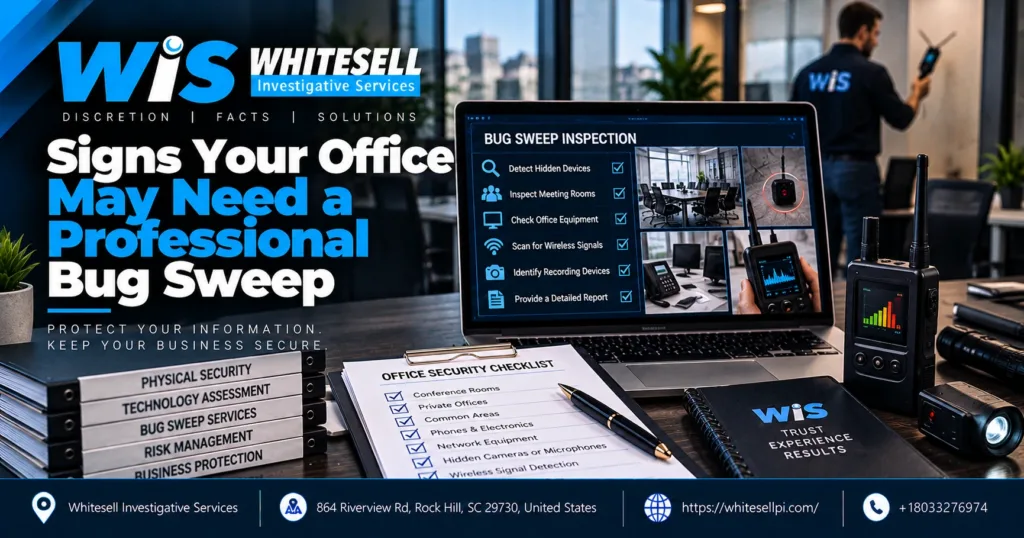
A professional TSCM bug sweep examines an environment for indicators of unauthorized technical surveillance and related security vulnerabilities.
The exact process depends on the location, risk profile, equipment, and reason for the inspection.
Physical Inspection
A physical examination can identify unfamiliar devices, altered fixtures, unexplained wiring, hidden components, or changes inconsistent with the normal office environment.
Electronic Assessment
Specialized equipment may be used to evaluate relevant electronic activity and identify signals or components that warrant further investigation.
Infrastructure Review
Inspectors may examine areas associated with power, communications, conference systems, office electronics, and other infrastructure depending on the scope of the assignment.
Professional TSCM work involves more than purchasing a handheld detector and scanning a room.
Modern offices contain numerous legitimate signals and electronic devices. Findings require interpretation, verification, and context.
The purpose is to evaluate anomalies systematically and document significant findings. A responsible provider should avoid promising that every conceivable surveillance method can always be detected under every circumstance.
Which Office Areas Are Commonly Checked?
Inspection priorities usually depend on where sensitive conversations occur and who can access those spaces.
Executive offices, conference rooms, boardrooms, legal meeting areas, and rooms used for confidential negotiations are common priorities.
Reception areas and visitor-accessible spaces can also matter when they provide opportunities to approach sensitive rooms or infrastructure.
Inspectors may consider furniture, fixtures, electrical areas, communications equipment, audiovisual systems, ceiling spaces, and other locations appropriate to the assessment.
The office layout influences the scope.
A small professional office may require a different approach from a corporate facility with multiple floors, shared conference areas, server rooms, and controlled executive spaces.
Access history matters as well.
A room frequently used by contractors, maintenance personnel, visitors, or outside organizations may present different concerns from a restricted area with tightly managed access.
Businesses should tell the TSCM professional where important meetings occur and identify recent renovations, maintenance visits, equipment installations, or unusual access events that may help establish inspection priorities.
What Should You Avoid Doing Before a Professional Sweep?
Avoid announcing the planned sweep broadly if there is a genuine concern about unauthorized surveillance.
Unnecessary disclosure could change circumstances before the inspection occurs.
Do not dismantle suspicious devices, open unfamiliar electronics, cut wires, remove batteries, or conduct aggressive searches unless an immediate safety issue requires action.
Moving an object can alter its condition or eliminate information useful for determining what it is and how it was installed.
Avoid experimenting with suspected equipment.
Do not connect unknown devices to company computers or networks. Do not attempt to access them electronically or test whether they transmit information.
Businesses should also avoid conducting sensitive conversations about the planned inspection in the area that is causing concern.
Use an appropriate alternative location and communication method when discussing the issue with authorized personnel.
Document observations without unnecessarily disturbing the environment. A professional can then evaluate conditions as they existed when the concern arose, which may provide more useful information than examining an area after employees have reorganized it.
How Should Potential Evidence Be Preserved?
Potential evidence should be handled as little as reasonably possible until qualified professionals determine the appropriate next step.
If an unfamiliar device or suspicious modification is discovered, record its location, appearance, and the circumstances surrounding the discovery.
Photographs may be useful when they can be taken safely without moving the object.
Limit access to the area when appropriate. Avoid allowing multiple employees to handle or inspect the item closely, since unnecessary contact can change its condition.
If there is a possible criminal issue, contact appropriate legal counsel or law enforcement for guidance.
Preservation procedures may depend on the nature of the item, the business environment, and whether authorities become involved.
Maintain notes about who discovered the item, when it was found, and any subsequent handling.
Do not make public accusations based solely on the discovery.
Preserving the condition and documenting facts allows investigators, attorneys, or law enforcement to evaluate the finding without relying on assumptions about who placed it or why.
When Should a Business Schedule a Professional Bug Sweep?
A business should consider a professional sweep when specific circumstances create a reasonable surveillance concern or when sensitive operations justify proactive security measures.
Repeated confidential information leaks, unexplained physical changes, suspicious devices, unauthorized access, and unusual events around sensitive meetings can support the decision.
Businesses may also incorporate TSCM into security planning before highly confidential negotiations, major transactions, litigation discussions, or executive meetings.
Another appropriate time is after a significant access event.
Office renovations, contractor work, changes in tenancy, unauthorized entry, or extended periods when sensitive spaces were outside normal control may justify reassessment depending on the risk.
Sweeps should not replace basic security.
Businesses still need appropriate physical access controls, cybersecurity practices, document protection, visitor management, and employee procedures.
When concerns arise, document the circumstances and discuss them discreetly with a qualified professional. A preliminary conversation can help determine whether a full TSCM inspection is warranted and which areas should receive priority.
FAQs
Does strange phone behavior mean my office is bugged?
Not necessarily. Telephone problems can result from ordinary hardware, software, network, or service issues. Repeated unexplained behavior may be worth documenting, particularly when other credible surveillance concerns are also present.
Can a consumer bug detector reliably sweep an office?
Consumer devices may detect certain signals, but interpreting those signals can be difficult in an office filled with legitimate wireless equipment. Professional TSCM combines specialized equipment, physical inspection, technical knowledge, and verification rather than relying on one detector.
Should employees search for hidden devices before a sweep?
A basic visual observation is different from dismantling equipment or aggressively searching an office. Employees should generally avoid moving suspicious items, opening fixtures, or testing unknown devices. Preserve conditions and seek professional guidance.
Can a bug sweep guarantee that no surveillance exists?
No responsible inspection can guarantee the absence of every possible surveillance method under all circumstances. A professional assessment examines the environment using appropriate procedures and documents findings and limitations based on the inspection scope.
Should a bug sweep be performed before or after a confidential meeting?
The timing depends on the risk and purpose. Some businesses schedule preventive sweeps before highly sensitive meetings, while others request an inspection after suspicious events. A TSCM professional can help define an appropriate scope and timing.
What should we tell a TSCM professional before the inspection?
Explain why surveillance is suspected, which rooms contain sensitive discussions, who has access, when unusual events occurred, and whether recent maintenance, construction, visitors, or equipment changes are relevant. Accurate context helps prioritize the assessment.
Key Takeaways
Possible signs that an office needs a professional bug sweep include repeated information leaks, unfamiliar devices, unexplained physical changes, suspicious access, or concerns surrounding sensitive meetings. Electronic interference alone does not prove surveillance, and ordinary technical problems can produce similar symptoms. Businesses should document concerns, restrict unnecessary discussion, and avoid dismantling or testing suspicious equipment. Professional TSCM combines physical inspection, technical assessment, and careful interpretation of findings. When potential evidence is discovered, preserve its condition and consider appropriate guidance from investigators, legal counsel, or law enforcement before taking further action.
Protect Sensitive Conversations With a Focused TSCM Assessment
When unexplained information leaks or suspicious office conditions create legitimate concerns, a structured technical assessment can provide clearer information. At Whitesell Investigation Services, we approach TSCM bug sweeps discreetly, examining relevant physical and electronic conditions while keeping the scope focused on the business’s specific security concerns.
We can review the circumstances that prompted concern, identify priority areas for inspection, and document significant findings. If your office handles sensitive negotiations, executive discussions, legal matters, or confidential business information, we can discuss whether a professional TSCM assessment is an appropriate next step.