
What Information Helps a Missing-Person Investigator Begin a Search?
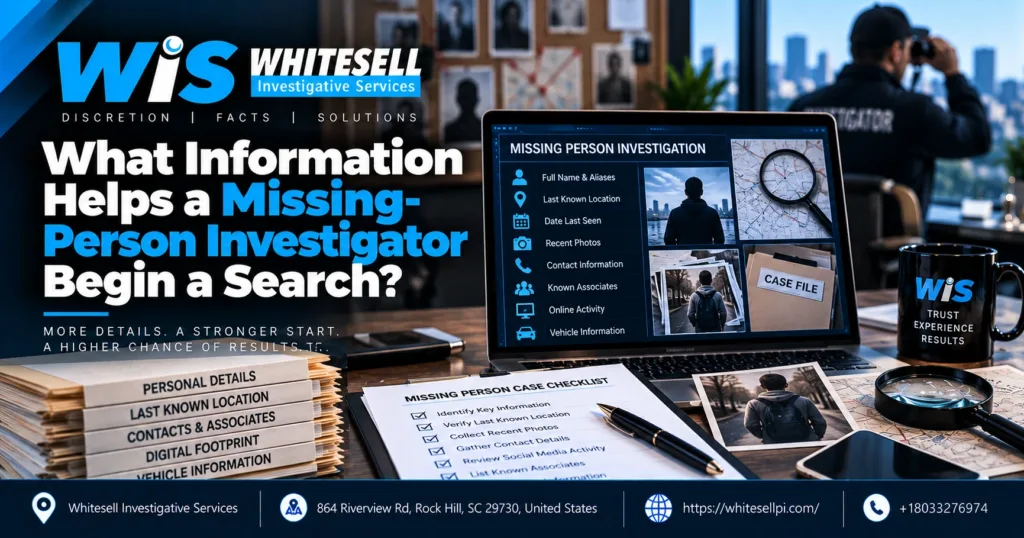
A missing-person investigator needs accurate identifying details, recent contacts, photographs, addresses, routines, vehicles, employment information, and a clear timeline to begin an effective search. The more reliable the starting information is, the easier it becomes to distinguish useful leads from unrelated records.
Families and authorized parties should gather facts without changing accounts, deleting messages, or altering potentially relevant information. Even details that initially seem minor can establish patterns, confirm identity, or narrow the search area. Organized information allows an investigator to prioritize leads and determine which lawful research methods are appropriate.
What Information Should You Gather Before a Missing-Person Investigation?
Start with information that establishes who the missing person is, where that person was recently located, and what was happening before contact stopped.
Useful starting details include the person’s full legal name, nicknames, previous names, date of birth, recent photograph, physical description, telephone numbers, email addresses, home address, employer, vehicle information, and known associates.
Recent circumstances also matter. Write down when the person was last seen or heard from, who had contact with them, where the contact occurred, and what was discussed.
Separate confirmed facts from assumptions. If someone reports seeing the person but cannot confirm the date, note that uncertainty rather than presenting the sighting as established.
Provide information in an organized form when possible. A chronological list is often more useful than scattered messages and recollections.
Do not delay contacting appropriate authorities in an emergency while attempting to assemble a perfect information package. Immediate safety concerns should be reported promptly to law enforcement or emergency services.
Which Personal Details Help Confirm Identity?
Accurate identity information helps an investigator avoid confusing the missing person with someone who has a similar name.
Provide the person’s complete legal name and any maiden names, former surnames, aliases, nicknames, or alternate spellings they commonly use. A date of birth or approximate age can further narrow records.
Physical characteristics may also be important. Height, approximate weight, hair and eye color, tattoos, scars, birthmarks, glasses, and other distinguishing features can help when evaluating sightings or photographs.
Historical identifiers provide additional context.
Previous addresses, schools, employers, professional licenses, businesses, and known relatives can connect older records with more recent information. These details become particularly useful when the person has moved frequently.
Accuracy matters more than quantity. Do not guess at identifying details simply to complete a list.
Tell the investigator which information is confirmed and which information is uncertain. That distinction helps determine how much weight a particular record or potential match should receive during the search.
Why Recent Contacts and Daily Routines Matter
A person’s normal routine creates a baseline. Changes from that baseline may help an investigator identify where to focus first.
List people who recently communicated with the missing person, including relatives, friends, coworkers, neighbors, business contacts, and other known associates. Provide available contact information and explain each person’s relationship to the subject.
Daily routines can provide additional context.
The investigator may need to know where the person normally worked, exercised, shopped, attended appointments, visited friends, or spent free time. Regular routes and frequently visited locations can help establish likely points of contact.
Recent changes deserve attention as well. A new job, relationship, residence, travel plan, conflict, or unusual interruption to a normal routine may help define relevant investigative questions.
Avoid interpreting every change as suspicious. Provide the facts and let the investigator assess their relevance alongside other information.
Knowing who had recent contact and what the person’s normal activities looked like can help establish a practical starting point rather than searching without direction.
What Employment, Address, and Vehicle Information May Be Useful?
Employment information can connect a missing person with coworkers, schedules, professional contacts, business locations, and other records.
Provide the current employer, job title, work location, known schedule, supervisor information, and previous employers when available. Self-employed individuals may have business names, professional licenses, customers, partners, or commercial addresses worth documenting.
Address history is equally useful.
Include the current residence, previous addresses, mailing addresses, and locations where the person regularly stayed. Note approximate dates whenever possible so the investigator can place each address in context.
Vehicle information can help distinguish the subject and identify possible travel patterns.
Useful details include the make, model, year, color, license plate, and any distinctive damage, stickers, modifications, or other recognizable features.
If the person sometimes used another vehicle, include that information and explain who owns it.
Do not attempt to access restricted vehicle or employment records yourself. Give known details to the investigator, who can determine which lawful sources and investigative steps are appropriate.
Can Digital and Financial Clues Support a Search?
Digital and financial information can sometimes provide useful context, but access to private accounts is legally restricted.
Provide known telephone numbers, email addresses, usernames, social media profiles, websites, and other online identifiers. These details can help an investigator distinguish genuine accounts from people with similar names.
Preserve recent messages, emails, voicemails, and other communications already lawfully available to you.
Dates and content may help establish the person’s recent activities, contacts, intentions, or locations. Do not impersonate the missing person or attempt to bypass passwords and security controls.
Financial information may also provide context when it is lawfully available. Known banks, employers, businesses, property interests, or recurring financial activities can sometimes guide investigative questions.
However, a private investigator does not automatically have authority to access private bank transactions or protected account information.
The availability of digital or financial information depends on legal authority, consent, circumstances, and applicable law. Investigators should use only permissible methods when developing these leads.
What Photos and Documents Should You Provide?
A recent, clear photograph is one of the most useful materials you can provide.
Choose images that accurately show the person’s current appearance. If appearance has recently changed, provide photographs showing those differences. Full-body photographs can sometimes supplement a clear facial image.
Avoid heavily filtered or edited images when better originals are available.
Documents can help verify identifying information and build a timeline. Depending on the circumstances and your lawful access, useful materials may include correspondence, business records, address information, travel details, calendars, photographs, or documents showing known affiliations.
Old documents can still be valuable.
A previous address, former employer, handwritten note, or older business connection may provide a link to information that becomes relevant later.
Keep original materials intact whenever possible. Provide copies rather than marking up originals.
Explain where each important document came from and approximately when it was created or received. Context allows an investigator to evaluate reliability rather than treating every document as equally current or significant.
What Information Should You Avoid Altering or Deleting?
Preserve original information whenever it may be relevant to the person’s disappearance or current location.
Do not delete text messages, emails, voicemails, photographs, call histories, social media communications, or other information simply because it seems unimportant. A small detail can become meaningful when compared with later findings.
Avoid editing screenshots or rewriting original messages.
If you need to highlight something for the investigator, make a separate copy and keep the original intact. Preserving dates, usernames, telephone numbers, and surrounding context can be important.
Do not log into accounts without authorization or attempt to guess passwords.
Unauthorized access can create legal and privacy problems. It may also interfere with evidence or information that law enforcement or another authorized party needs to preserve.
If you believe a device or account contains important information, tell the investigator or law enforcement agency involved.
Preservation is generally safer than experimentation. Keep available information unchanged and document how you obtained anything you provide.
Why Dates and Timelines Are Important
A timeline helps transform disconnected details into an understandable sequence of events.
Start with the last confirmed contact and work backward through relevant events. Record dates, approximate times, locations, people involved, and how each fact was confirmed.
Then document events occurring after contact stopped.
These might include missed appointments, returned mail, reported sightings, messages from other people, unusual communications, or attempts to reach the person.
Distinguish exact times from estimates. Writing “approximately 6 p.m.” is more useful than presenting an uncertain time precisely.
Conflicting accounts should also be preserved rather than silently reconciled. If two people remember an event differently, record both versions and identify their sources.
A strong timeline helps investigators recognize gaps, inconsistencies, and periods requiring closer examination.
It also reduces repeated work. Instead of reconstructing the same events during every conversation, investigators can refer to an organized chronology and update it as reliable information develops.
How Is Sensitive Information Handled Discreetly?
Missing-person investigations can involve private family matters, addresses, relationships, employment details, communications, and other sensitive information.
A professional investigator should collect information relevant to the legitimate purpose of the search and handle it carefully.
Not every detail needs to be shared with every person contacted during an investigation. Investigators can often make inquiries without disclosing unnecessary personal information or the complete circumstances surrounding the search.
The specific level of confidentiality depends on the assignment, applicable law, and whether law enforcement, attorneys, courts, or other parties are involved.
Clients should also use discretion.
Avoid publicly posting sensitive identifiers, private account information, financial details, or unverified accusations in an attempt to generate leads. Public distribution can create privacy concerns and produce misleading information.
During the initial discussion, ask how records, reports, and communications will be handled. Understanding who receives investigative findings and how sensitive information will be used helps establish appropriate expectations before research begins.
What Happens During the Initial Investigator Consultation?
The initial consultation allows the investigator to understand who is missing, why the search is being requested, and what information already exists.
Expect questions about identity, last known contact, recent addresses, employment, vehicles, associates, routines, communications, and previous attempts to locate the person.
The investigator may ask whether law enforcement has been contacted and whether another investigation is active.
Be direct about facts that may seem uncomfortable or insignificant. Incomplete information can send a search in the wrong direction, while accurate context helps investigators prioritize relevant leads.
The investigator should also explain the proposed scope, lawful research methods, reporting process, anticipated costs, and important limitations.
Not every missing-person matter requires the same approach.
A recent disappearance involving immediate safety concerns differs significantly from locating an estranged adult relative or a person who has intentionally lost contact.
The consultation helps determine whether private investigative assistance is appropriate and what next steps make sense.
FAQs
How soon should I contact a missing-person investigator?
You can seek professional guidance when reasonable attempts to make contact fail or circumstances create concern. If there is an immediate threat to someone’s safety, contact law enforcement or emergency services promptly rather than waiting for a private investigation.
What if I have very little information about the missing person?
Provide whatever reliable information you have. A full name, approximate age, old address, photograph, relative, employer, telephone number, or email address may create a starting point. Clearly identify details that are uncertain.
Should I provide social media information?
Yes, provide known profile names, usernames, URLs, and screenshots already lawfully available to you. Do not attempt to defeat privacy settings, impersonate the person, or access accounts without authorization.
Can an investigator track a missing person’s phone?
Private investigators do not have unrestricted authority to access private location data or track a person’s device. Access to protected information depends on consent, legal authority, applicable law, and the circumstances of the case.
Should I contact the missing person’s friends myself?
That depends on the circumstances. Before contacting numerous people, consider discussing the approach with the investigator or law enforcement involved. Uncoordinated outreach can sometimes create confusion, duplicate efforts, or influence what witnesses later remember.
What should I bring to the first consultation?
Bring accurate identifying details, recent photographs, a timeline, contact information for relevant people, known addresses, employment information, vehicle details, and copies of potentially useful communications or documents. Keep original materials preserved and unchanged.
Key Takeaways
A missing-person investigation begins with accurate facts, not assumptions. Personal identifiers, recent photographs, contacts, routines, addresses, employment information, vehicles, communications, documents, and a clear timeline can help an investigator establish productive starting points. Preserve original messages and records rather than altering, deleting, or accessing protected accounts without authorization. Clearly separate confirmed information from uncertain reports. Sensitive details should be handled carefully and shared only as appropriate. When immediate safety concerns exist, contact law enforcement promptly. Organized, reliable information helps professional investigators evaluate leads efficiently and choose lawful search methods.
Give the Search a Clear and Reliable Starting Point
When someone cannot be located, organized information can help turn scattered details into useful investigative leads. At Whitesell Investigation Services, we begin by reviewing what is known, identifying gaps, and determining which lawful research methods fit the circumstances.
We can help clients organize identifying information, timelines, contacts, addresses, and other relevant details before investigative work begins. We also explain what information may require additional verification and what investigative limitations apply. If you need professional assistance locating someone, we can review the available facts and discuss an appropriate, discreet path forward.