
How to Investigate Suspected Inventory Theft
To investigate suspected inventory theft, businesses should first confirm the loss through inventory records, transaction histories, access logs, and available surveillance footage before focusing on any individual. The investigation should preserve evidence, establish a reliable timeline, and distinguish documented facts from assumptions.
Inventory discrepancies can result from theft, but they can also involve receiving errors, damaged goods, incorrect counts, vendor issues, or administrative mistakes. A structured investigation helps determine what happened, identify recurring patterns, protect evidence, and support appropriate business, legal, insurance, or law enforcement decisions when further action becomes necessary.
What Are the Warning Signs of Inventory Theft?
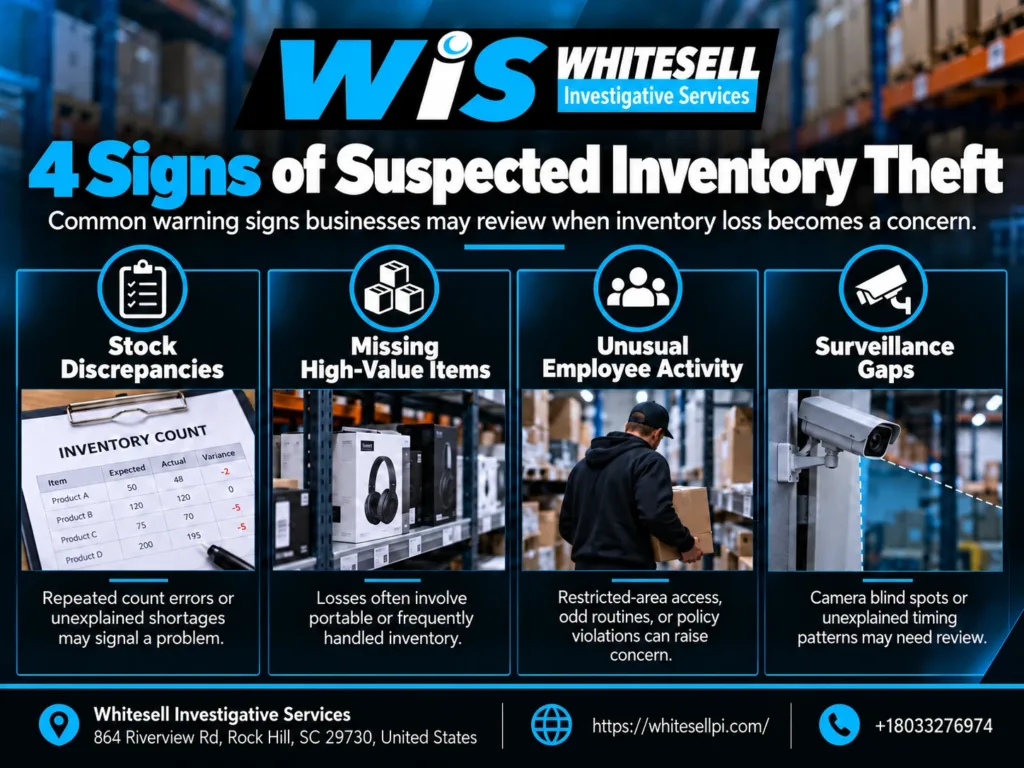
Repeated inventory shortages can justify closer review, particularly when losses affect specific products, locations, shifts, or periods. A single discrepancy, however, should not automatically be treated as evidence of theft.
Businesses should look for patterns.
Unexplained stock adjustments, unusual write-offs, missing high-value products, inconsistent receiving records, repeated shortages, or discrepancies between physical counts and inventory systems may warrant examination.
Timing can provide useful context. If losses repeatedly occur during particular shifts or after specific deliveries, investigators may compare those periods with access, transaction, staffing, and surveillance records.
Changes in inventory activity should still be evaluated carefully. Poor recordkeeping, scanning errors, damaged merchandise, incorrect shipments, and administrative mistakes can produce similar warning signs.
The purpose of identifying indicators is to determine where factual review should begin, not to identify a suspect prematurely.
A disciplined investigation tests possible explanations against available evidence before reaching conclusions.
How Can You Tell Internal Theft From External Loss?
Determining whether inventory loss is internal or external requires comparing how products move through the business.
Internal loss may involve employees or other individuals with authorized access. External loss may involve customers, unauthorized visitors, organized retail activity, burglary, or other outside sources.
The distinction is not always obvious.
Investigators can examine where inventory disappeared, who could access that area, when discrepancies occurred, and whether corresponding transactions or adjustments exist.
External loss may be supported by surveillance footage, damaged security measures, suspicious customer activity, or other documented events. Internal concerns may arise when losses repeatedly correspond with restricted access, unexplained adjustments, or particular operational patterns.
Neither pattern automatically establishes responsibility.
Businesses should also consider non-theft explanations before categorizing a loss. Receiving mistakes, shipping errors, damaged merchandise, inaccurate counts, and improperly recorded transfers can create apparent shortages.
Following the inventory trail helps narrow possibilities without making unsupported accusations.
What Inventory Records Should Be Reviewed First?
The first records reviewed should establish what inventory should have existed and what actually happened to it.
Start with physical inventory counts and compare them with the inventory management system. Determine which products are missing, how many units are affected, and when the discrepancy first becomes identifiable.
Next, examine receiving records, purchase orders, shipping documents, sales transactions, transfers, returns, refunds, write-offs, damaged inventory, and manual adjustments.
Why are adjustments important?
Inventory adjustments can explain legitimate discrepancies, but unusual adjustment patterns may also identify areas requiring additional review.
Investigators should determine who made an adjustment, when it occurred, what reason was recorded, and whether supporting documentation exists.
The same approach applies to refunds, voids, discounts, and returns when they affect inventory.
Records should be reviewed chronologically whenever possible. A timeline can reveal where the expected inventory trail stops matching documented activity.
Good investigations begin with records because those records can narrow the relevant dates, products, locations, and people before more intrusive investigative steps are considered.
How Can Surveillance Footage Support an Investigation?
Surveillance footage can help establish what occurred in areas where missing inventory was stored, handled, sold, received, or transferred.
Investigators may compare footage with the timeline developed from inventory and transaction records.
For example, if records identify a narrow period when merchandise disappeared, available footage from that period may show who entered the relevant area, how products were handled, or whether an external event occurred.
Video should be interpreted cautiously.
A person appearing near missing inventory does not establish that the person stole it. Footage may lack important context, contain blind spots, or fail to show what happened before or after a recorded event.
Businesses should preserve relevant recordings quickly because many systems automatically overwrite older footage.
Original files should be retained when practical, and copies used for routine review. Investigators should document which cameras, dates, and periods were examined.
Surveillance is most useful when combined with other evidence rather than viewed independently.
What Access and Transaction Records May Reveal
Access records can help establish who had the ability to enter locations connected with missing inventory.
Depending on the business, relevant records may include badge access, key assignments, alarm logs, electronic entry records, warehouse access, vehicle records, or authorized user histories.
Transaction records provide another layer.
Point-of-sale activity, inventory adjustments, refunds, voids, transfers, shipping records, and system login histories can help investigators reconstruct what occurred around a loss.
The objective is pattern identification.
If a discrepancy consistently follows a particular type of transaction, investigators can examine that process more closely. If losses occur in a restricted area, access records can help identify who could legitimately enter during the relevant period.
Records must still be interpreted in context.
Shared credentials, delayed system entries, authorized access, malfunctioning equipment, and incomplete records can complicate conclusions.
Investigators should use these records to develop and test factual timelines rather than assume that access establishes responsibility.
How Are Employees Interviewed During an Inventory Theft Investigation?
Employee interviews should gather information, clarify procedures, and test documented facts without beginning from an assumption of guilt.
Investigators often prepare by reviewing available records first. This allows questions to focus on specific processes, dates, responsibilities, and events.
An employee may explain how inventory is received, stored, counted, transferred, or discarded. That information can reveal procedural weaknesses or legitimate explanations for discrepancies.
Questions should be clear and professional.
Interviewers should distinguish between what the employee personally observed and what the employee heard from someone else. Important statements should be documented accurately.
Businesses should also consider applicable employment policies, legal requirements, collective bargaining obligations, and guidance from counsel where appropriate.
Aggressive accusations can damage the investigation and may cause unnecessary workplace problems when evidence remains incomplete.
An interview is one information source. Statements should be compared with records and other independently available evidence before conclusions are reached.
When Should Vendors or Contractors Be Reviewed?
Vendors, delivery personnel, contractors, temporary workers, and other third parties may warrant review when they have relevant inventory access or involvement in the supply chain.
The review should be based on evidence, not assumptions about outside workers.
Investigators may examine delivery records, invoices, purchase orders, receiving documentation, access information, and discrepancies between quantities ordered, shipped, received, and entered into inventory.
Repeated shortages connected with particular deliveries may justify closer examination.
Contractors with access to warehouses, stockrooms, loading areas, or other controlled spaces may also become relevant when the documented timeline overlaps with their access.
Vendor problems do not always involve theft.
Incorrect quantities, damaged shipments, fulfillment errors, paperwork mistakes, and receiving problems can create inventory discrepancies.
The investigation should therefore trace products through each stage of the supply process.
Reviewing third parties prevents businesses from focusing exclusively on employees when the evidence points elsewhere.
Why Documentation and Evidence Preservation Matter
Documentation gives an inventory theft investigation structure and allows findings to be reviewed later.
Investigators should maintain a clear chronology of relevant events, records reviewed, interviews conducted, observations made, and evidence preserved.
Original records should be protected from unnecessary alteration.
Relevant surveillance footage, transaction records, access logs, inventory reports, photographs, correspondence, and other materials should be preserved according to appropriate business and legal requirements.
Investigators should also document where important evidence originated.
Why does context matter?
An isolated screenshot or transaction may be misleading without information showing when it occurred and how it relates to the inventory loss.
Clear documentation allows attorneys, insurers, business leaders, or law enforcement to understand the investigative process if the matter is escalated.
Evidence preservation also reduces the risk that useful information disappears because systems overwrite records or routine retention schedules delete them.
Professional documentation separates verified facts, reported information, and investigative interpretation.
That distinction strengthens the reliability of the final findings.
How Can Businesses Prevent Continued Inventory Losses?
Businesses can reduce continued losses by addressing vulnerabilities identified during the investigation rather than relying only on disciplinary action.
Start with inventory controls.
Regular cycle counts, clear receiving procedures, documented transfers, restricted adjustment permissions, and reconciliation of physical stock with system records can make discrepancies easier to detect.
Access controls should match job responsibilities.
High-value inventory may require limited access, individual credentials, stronger key management, or documented authorization for removal.
Businesses should also review surveillance coverage and record-retention periods. Cameras should support legitimate security objectives while complying with applicable privacy and workplace requirements.
Separation of duties can reduce opportunities for one person to control receiving, adjustment, transfer, and reconciliation processes without oversight.
Employees should understand inventory procedures and how suspected losses should be reported.
Prevention is strongest when controls make inventory movement traceable. The goal is not constant suspicion. It is creating accountable processes that identify errors and losses earlier.
When Should a Professional Investigator Be Involved?
A professional investigator may be appropriate when inventory losses are substantial, recurring, difficult to explain, or potentially connected with organized or internal activity.
Outside assistance can also be useful when management needs an independent review.
Professional investigators can help organize records, establish timelines, conduct appropriate interviews, review available evidence, and identify factual inconsistencies requiring additional investigation.
Complex matters may involve multiple locations, employees, vendors, transactions, or extended periods. An organized investigative process can prevent important evidence from being overlooked.
Businesses should consider involving counsel or appropriate authorities when circumstances create significant legal, employment, criminal, or regulatory concerns.
Investigators do not replace those professionals.
Their role is to develop and document facts within the lawful scope of the assignment.
Early professional involvement may also help preserve time-sensitive records before surveillance footage, electronic logs, or other information becomes unavailable.
FAQs
What should a business do first when inventory theft is suspected?
Confirm that an actual discrepancy exists. Compare physical counts with inventory, receiving, sales, transfer, return, and adjustment records before assuming theft occurred.
Should an employee be confronted immediately?
Generally, businesses benefit from preserving and reviewing available facts before making accusations. Premature confrontation can disrupt an investigation and may unfairly target someone when the cause of the discrepancy remains uncertain.
Can surveillance footage prove inventory theft?
Footage can provide important evidence, but it should be evaluated with records and surrounding context. Simply appearing near missing inventory does not establish responsibility.
How long should an inventory theft investigation take?
There is no universal timeframe. The duration depends on the volume of records, number of people involved, available evidence, locations affected, and complexity of the loss.
Should businesses report inventory theft to law enforcement?
That decision depends on the evidence, circumstances, value of the loss, applicable requirements, and advice from appropriate legal or insurance professionals. Businesses should preserve relevant evidence before making consequential decisions.
Can inventory theft involve vendors as well as employees?
Yes. Employees, customers, vendors, contractors, or other individuals with access may become relevant depending on the evidence. Administrative and supply-chain errors should also be considered before theft is concluded.
Building a Clear Investigation From the Evidence
Suspected inventory theft requires a measured response because inaccurate assumptions can create additional financial, legal, and workplace problems. At Whitesell Investigation Services, we approach business investigations by following documented facts and identifying where records, interviews, surveillance, or other evidence can clarify what occurred.
We help clients establish timelines, examine relevant information, preserve findings, and understand where additional investigation may be justified. If unexplained inventory losses are continuing or internal resources cannot determine their source, we can discuss the circumstances and develop an investigative scope appropriate to the business and the available evidence.
Key Takeaways
Inventory theft investigations should begin by confirming discrepancies and tracing inventory through receiving, storage, transactions, transfers, and adjustments. Surveillance footage, access logs, interviews, vendor records, and transaction histories can help establish a reliable timeline, but no single fact should automatically determine responsibility. Businesses should preserve relevant evidence, document findings carefully, and consider legitimate errors alongside possible theft. Strong internal controls can reduce continued losses while making future discrepancies easier to identify. When losses are substantial, recurring, or complex, professional investigative support can provide independent, organized factual review.