
Social Media Evidence in Insurance Investigations
Social media evidence in insurance investigations can provide publicly available information that helps investigators verify activities, timelines, relationships, locations, or statements relevant to a claim. Investigators must collect and preserve that information carefully, document its context, and avoid treating a single post as conclusive proof.
Social media content can support claim review when it is relevant, lawfully accessible, and properly documented. Its value depends on account verification, dates, surrounding context, preservation methods, and comparison with other evidence. A photograph or post may raise questions, but reliable investigations require broader factual review.
When Does Social Media Become Relevant in an Insurance Investigation?
Social media becomes relevant when publicly available content may help answer a legitimate question connected to an insurance claim. Investigators should have a defined investigative purpose rather than searching accounts simply because a claimant uses social media.
Relevant content may concern activities, locations, dates, relationships, property, travel, employment, business activity, or other facts connected to issues being reviewed.
For example, a public post may indicate that an individual attended an event on a particular date. Another post might show property conditions or an activity that warrants comparison with information contained in a claim.
Relevance does not mean proof.
A photograph showing physical activity cannot establish how someone felt, how long the activity lasted, or whether discomfort occurred afterward. Similarly, a photograph of property may not establish when damage occurred.
Professional investigators therefore identify potentially relevant information and document it objectively. Insurers, attorneys, claims professionals, and other authorized parties can determine its significance alongside the complete claim record.
The investigative question should guide the research from beginning to end.
What Public Social Media Information Can Investigators Review?
Investigators may review social media information that is publicly accessible and relevant to a legitimate investigation, subject to applicable laws and professional requirements.
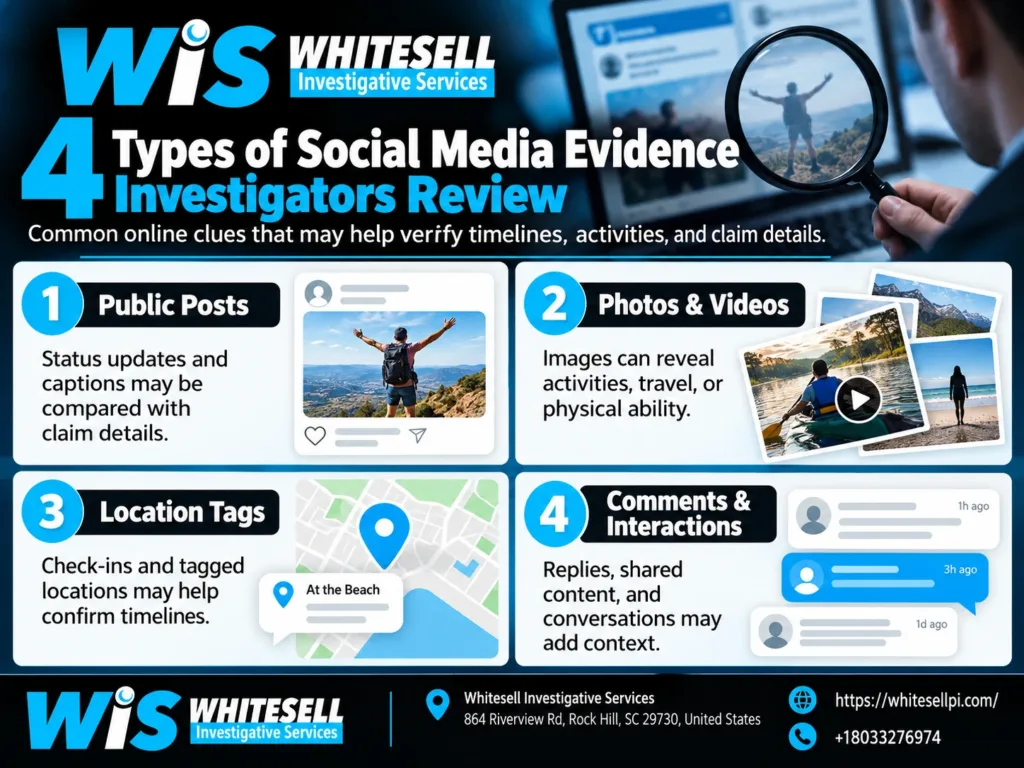
Public information may include posts, photographs, videos, profile information, public comments, publicly visible connections, event information, business pages, and other material available without gaining unauthorized access to restricted content.
The exact information available depends on the platform and the privacy choices associated with an account.
What makes information relevant?
Relevance depends on the investigative objective.
A public photograph may matter because of its date, location, visible activity, or relationship to another person. A public business profile could help verify employment or commercial activity. A public comment may provide context concerning a particular event.
Investigators should avoid collecting large amounts of unrelated personal information merely because it is available.
Focused research produces clearer documentation and reduces the risk of drawing conclusions from information unrelated to the claim.
The purpose is to identify facts that reasonably relate to questions under review.
What Is the Difference Between Public and Private Social Media Content?
Public social media content is information a user has made accessible without requiring special permission to view it. Private or restricted content is information protected by account settings, membership restrictions, approval requirements, or other access controls.
That distinction matters during professional investigations.
Investigators should not assume that information becomes fair to access simply because it exists online. Applicable laws, platform restrictions, privacy considerations, and professional standards can affect how information may be obtained.
Attempting to circumvent access controls can create legal, ethical, and evidentiary concerns.
Professional social media research therefore emphasizes lawful access and accurate documentation. Investigators should know how the information became available and be able to explain the circumstances under which it was observed.
Public availability also does not eliminate the need for relevance.
An investigator may encounter personal information unrelated to the claim. Responsible investigation remains focused on material connected to the authorized investigative purpose rather than collecting everything visible on an account.
How Do Investigators Verify Account Ownership?
Finding an account with the correct name does not automatically establish that it belongs to the person involved in an insurance claim.
Names may be shared by many people. Accounts can use nicknames, altered spellings, outdated photographs, pseudonyms, or incomplete profile information. Fake and impersonation accounts can also exist.
Investigators therefore look for multiple identifiers that may connect an account with the correct individual.
These could include profile photographs, geographic references, employment information, publicly identified relatives, business affiliations, education history, or other consistent details.
No single identifier should necessarily be treated as conclusive.
Why does verification matter?
Misidentifying an account can compromise an investigation.
If information from another person’s profile is attributed to a claimant, subsequent comparisons and conclusions may be unreliable. Account verification should therefore occur before potentially relevant posts are presented as associated with a particular individual.
Investigative reports should also avoid overstating certainty when ownership cannot be fully established.
Careful attribution protects both the accuracy of the investigation and the usefulness of the resulting evidence.
How Is Social Media Evidence Preserved Correctly?
Social media content can change quickly. Posts may be edited, deleted, restricted, or removed, and account settings can change after information is first observed.
Investigators therefore need a consistent preservation process.
Documentation may include capturing the visible content, recording the date and time it was accessed, identifying the account or page, preserving relevant surrounding information, and noting how the material was publicly available.
The goal is to preserve enough information for another reviewer to understand what investigators actually observed.
A screenshot without context can create problems. It may omit the account identity, date, caption, comments, or surrounding information necessary to understand what the image represents.
Investigators should also maintain organized records connecting preserved social media material with their investigative notes and reports.
Preservation does not make content automatically authentic or decisive. It establishes a record of what was observed online at a particular point during the investigation.
Why Dates, Context, and Metadata Matter
Dates are critical because social media content does not always represent activity occurring on the day a post appears.
Someone may upload an old photograph, repost another person’s content, share a memory, or publish material days after an event occurred.
Captions can also be ambiguous.
A post saying someone is “back at the beach” does not necessarily establish when the accompanying photograph was taken. Investigators should distinguish the posting date from the date of the depicted activity whenever that distinction can be determined.
Context matters for the same reason.
A photograph viewed by itself may create a different impression from the same photograph viewed with its caption, surrounding posts, or relevant chronology.
Available metadata or platform information may provide additional context, but investigators should avoid claiming that technical information proves more than it actually establishes.
Precise documentation reduces the risk of presenting an assumption as a verified fact.
How Social Posts May Be Compared With Claim Statements
Social media research can identify information that may be compared with statements or records associated with an insurance claim.
The comparison should remain factual.
Suppose a claim contains information about physical restrictions and a public post appears to show relevant activity. An investigator can preserve and describe the post, document the available date information, and identify the observable activity.
The investigator should not automatically conclude that the post disproves the claimed restriction.
A photograph captures a moment. It may not show duration, pain, assistance, recovery time, or circumstances before and after the activity.
The same principle applies to property, travel, employment, or other insurance matters.
Investigators document apparent consistencies or inconsistencies that warrant review. Appropriate claims, legal, medical, or insurance professionals determine what those facts mean within the larger matter.
This separation helps prevent social media research from becoming speculation.
What Are the Limits of Social Media Evidence?
Social media evidence has significant limitations.
Posts are curated. Photographs can be old. Captions can be humorous, exaggerated, incomplete, or unrelated to when an image was created. Accounts may also be shared, impersonated, or incorrectly attributed.
Social media rarely provides a complete picture of someone’s daily activity.
A person might post one photograph from a short event while spending the remainder of the day inactive. A business might publish scheduled content that does not establish where a particular person was when the post appeared.
Investigators must therefore resist interpreting isolated content too broadly.
Another limitation is authenticity. Content may be edited or reposted, and investigators may not always have access to original files or complete technical information.
These limitations do not make social media useless. They explain why careful verification, preservation, context, and corroboration are essential before online information receives significant weight in an investigation.
Can Social Media Content Be Used in Legal or Insurance Proceedings?
Social media content may become relevant in insurance, litigation, or other legal proceedings, but its usefulness depends on the circumstances.
Questions may arise concerning relevance, authenticity, preservation, access, attribution, and applicable evidentiary requirements.
Investigators should not promise that a particular screenshot, photograph, video, or post will be admissible in court.
Admissibility is a legal question that can depend on jurisdiction, the proceeding, how information was obtained, how it was preserved, and other factors.
The investigator’s responsibility is different.
Professional investigators should document online information carefully, maintain an accurate record of how it was observed, and avoid altering or mischaracterizing the material.
Attorneys and other appropriate professionals can then evaluate how the information may be used.
Reliable investigative practices make that later evaluation easier because the documentation provides a clearer factual foundation.
Why Social Media Evidence Should Be Reviewed With Other Documentation
Social media evidence is strongest when considered with other reliable information rather than evaluated in isolation.
An insurance investigation may include claim statements, records, photographs, surveillance observations, interviews, public records, timelines, or other documentation. Each source can provide a different context.
A social media post might identify an activity worth examining. Surveillance could provide additional observations. Records might establish dates or circumstances. Other documentation may explain an apparent inconsistency.
Corroboration also helps investigators recognize misleading impressions.
A post that initially appears important may become less significant after the date is verified. Conversely, multiple independent sources may establish a clearer timeline around an event.
Professional investigations should follow the evidence rather than force individual pieces of information into a predetermined conclusion.
That approach helps insurers and other decision-makers receive a balanced record that identifies both relevant findings and meaningful limitations.
FAQ
Can insurance investigators look at social media accounts?
Investigators may review lawfully accessible social media information when it is relevant to an authorized investigation. Access to private or restricted information raises different legal, privacy, and professional considerations.
Does deleting a social media post remove the evidence?
A deleted post may no longer be publicly visible, but copies may already have been preserved by authorized parties. Questions concerning preservation obligations or legal consequences should be addressed by qualified legal counsel.
Can a social media photograph prove an insurance claim is false?
A photograph alone rarely establishes the full circumstances surrounding a claim. Investigators should consider dates, context, account ownership, observable facts, and other available documentation before drawing conclusions.
How do investigators know a social media account belongs to the claimant?
Investigators may compare multiple identifiers, such as photographs, geographic information, employment details, relatives, business connections, and other consistent public information. Account ownership should not be assumed based only on a matching name.
Why should investigators preserve the entire context of a post?
Context helps reviewers understand what was actually published and reduces the risk of misinterpreting an isolated screenshot. Dates, captions, account information, surrounding material, and access details may all be relevant.
Should social media evidence be investigated further?
Further investigation may be appropriate when online information raises a legitimate question that cannot be resolved from the post itself. Any additional work should have a defined investigative purpose and remain proportionate to the needs of the matter.
Objective Social Media Research for Insurance Claims
When social media information becomes relevant to an insurance matter, careful collection matters as much as finding the information itself. At Whitesell Investigation Services, we approach social media research as one component of a broader factual investigation.
We focus on relevant, lawfully accessible information, careful documentation, account verification, chronology, and context. We do not treat an isolated post as an automatic conclusion about a claim. If your organization needs professional support reviewing social media evidence as part of an insurance investigation, we can discuss the investigative objective and determine an appropriate scope for the matter.
Key Takeaways
Social media evidence can provide useful information during an insurance investigation, but its value depends on careful verification, lawful access, preservation, and context. Investigators should confirm account ownership, distinguish posting dates from event dates, document relevant material accurately, and avoid treating isolated posts as conclusive proof. Public information may support comparisons with claim statements, but it should be reviewed alongside records, surveillance, interviews, and other evidence. Professional social media research remains focused on objective facts, reasonable investigative questions, and balanced reporting that acknowledges important limitations clearly.