
How Workplace Harassment Investigations Are Conducted
Workplace harassment allegations can place employers in a difficult position. HR leaders and managers may need to respond quickly, but they also need to avoid assuming that an allegation is either true or false before the facts have been reviewed.
A workplace harassment investigation is a structured fact-finding process used to understand what happened, who was involved, what evidence exists, and whether available information supports or contradicts the allegations. Depending on the situation, the investigation may be handled internally or assigned to an independent outside investigator.
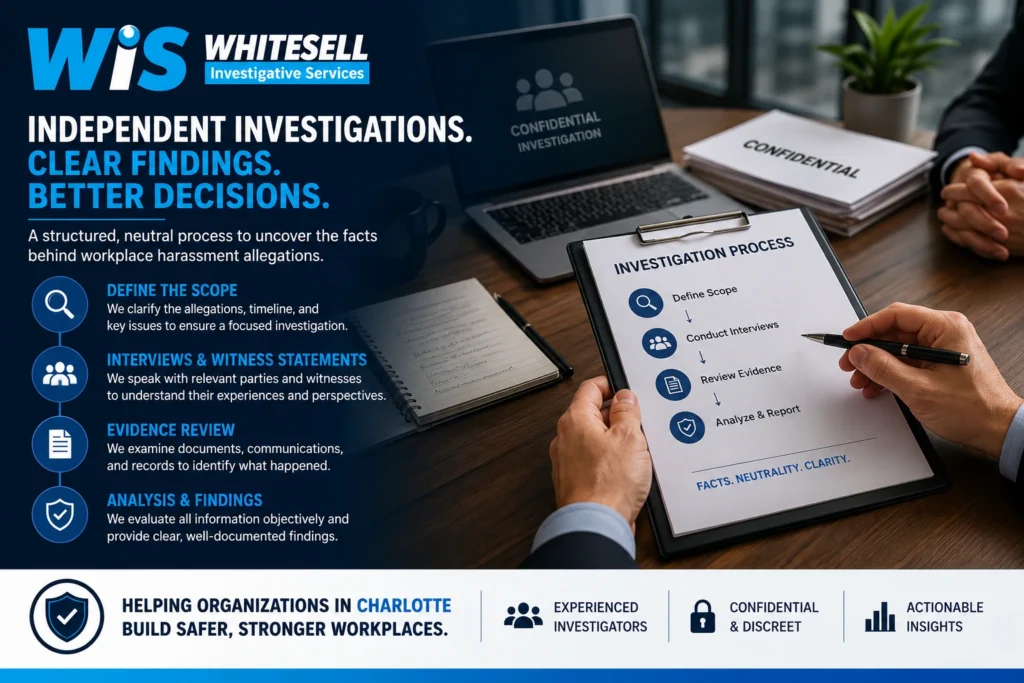
The exact process varies by organization and case. However, most investigations involve defining the scope, identifying relevant people and records, conducting interviews, reviewing evidence, comparing accounts, and documenting findings so organizational leaders can determine appropriate next steps.
What Is a Workplace Harassment Investigation?
A workplace harassment investigation is an inquiry into allegations of inappropriate or prohibited conduct in the workplace.
The investigator’s role is typically to gather and evaluate information rather than advocate for the person making the complaint or the person responding to it. The process may examine allegations involving harassment, discrimination, retaliation, hostile workplace conduct, policy violations, or related employee concerns.
An effective investigation focuses on facts.
That may include determining:
- What conduct was alleged
- When and where it may have occurred
- Who was involved
- Who may have witnessed relevant events
- What records or communications may exist
- Whether different sources of evidence support or contradict one another
The investigator generally does not begin with a conclusion. Instead, the goal is to develop as complete and neutral an understanding of the circumstances as the available evidence allows.
When Is an Outside Workplace Investigator Appropriate?
Many employers handle routine employee concerns through HR or internal management. However, some situations may benefit from an independent investigator.
When Internal Neutrality May Be Difficult
An outside investigator may be appropriate when someone involved in the complaint is a senior executive, HR leader, owner, or another person who would normally participate in an internal investigation.
Using an independent investigator can help create greater separation between the people involved in the allegation and the person responsible for examining it.
When the Matter Is Especially Sensitive or Complex
Outside assistance may also be considered when:
- Multiple employees are involved
- Allegations involve senior leadership
- There are concerns about internal conflicts of interest
- Several complaints appear related
- The investigation involves extensive records or interviews
- The organization lacks internal investigative resources
- Previous internal findings are being questioned
- A neutral third-party perspective would help clarify the facts
Organizations considering independent assistance can review Whitesell Investigative Services’ Corporate HR Investigator services for HR-focused workplace matters.
What Happens at the Beginning of a Harassment Investigation?
An investigation usually begins by establishing what needs to be examined.
This is often referred to as defining the scope.
The scope may identify the allegations being reviewed, the approximate time period involved, the people who may need to be interviewed, and the types of evidence that may be relevant.
Records Should Be Identified Early
Employers may also need to preserve relevant records so that important information is not lost or routinely deleted while the investigation is underway.
Depending on the case, this may include workplace communications, HR documentation, schedules, policies, reports, or other business records.
The investigator may also develop an initial timeline based on the information available at the beginning of the inquiry.
The scope can change as new information emerges. An interview, document, or other piece of evidence may identify additional witnesses or issues that reasonably need to be examined.
How Are Workplace Investigation Interviews Planned?
Interviews are a central part of many harassment investigations.
The investigator typically determines who should be interviewed and in what sequence based on the allegations, available records, and information gathered as the investigation progresses.
The purpose is not simply to collect opinions. Interviews are used to understand what each person personally experienced, observed, communicated, or knows about the events being investigated.
Questions Should Focus on Relevant Facts
Interview topics may address:
- What happened
- When events occurred
- Where they occurred
- Who was present
- What was said or done
- Whether communications or documents exist
- Whether anyone else may have relevant information
Follow-up questions may be necessary when accounts are unclear or when new information emerges.
The exact interview process can vary depending on company procedures, the nature of the allegations, and other circumstances surrounding the case.
Who May Be Interviewed During the Investigation?
A workplace harassment investigation may involve several types of interview subjects.
The Complainant
The person who reported the concern may be asked to describe the alleged conduct, identify relevant dates or locations, provide supporting records, and name people who may have witnessed or learned about the events.
The Respondent
The person accused of misconduct generally has an opportunity to respond to the allegations and provide their account, relevant records, and potential witnesses.
An allegation should not be treated as established simply because it has been reported.
Witnesses
Witnesses may include people who directly observed an incident as well as individuals who possess relevant information about communications, workplace circumstances, or events surrounding the allegation.
Not every person mentioned during an investigation necessarily needs to be interviewed. Investigators generally focus on people whose information may help clarify the facts.
What Evidence Does a Workplace Harassment Investigator Review?
The evidence reviewed depends on the allegations and how the organization communicates and maintains records.
Common sources may include:
- Emails
- Text messages or workplace messaging platforms
- HR records
- Employee complaints
- Schedules and time records
- Policies and handbooks
- Meeting records
- Written statements
- Workplace documents
- Access or entry records when relevant and lawfully available
- Photographs or other provided materials
An investigator may also compare these records with statements made during interviews.
Evidence Should Be Viewed in Context
A single message or document may not tell the entire story.
Investigators may consider when a communication was sent, what happened before and after it, whether other records support the same timeline, and whether the people involved provide consistent accounts.
The goal is to evaluate evidence as part of the larger factual picture.
How Are Confidentiality and Neutrality Handled During an Investigation?
Workplace investigations often involve sensitive personal and organizational information.
Confidentiality is therefore important, but it should not generally be described as absolute.
Confidentiality Is Often Limited to Need-to-Know Sharing
Certain information may need to be shared with witnesses, HR personnel, management, legal counsel, or others involved in evaluating or responding to the matter.
An investigator can limit unnecessary disclosure while still gathering the information required to conduct the investigation.
Employees should not be promised that no one else will ever learn what they reported if the information may need to be addressed as part of the process.
Neutrality Is Essential to Credibility
An investigator should approach the matter as a fact-finder rather than as an advocate for either side.
That means allowing allegations to be tested against interviews, documentation, timelines, and other available evidence.
Independence can be particularly valuable when internal relationships or organizational hierarchy could create questions about impartiality.
How Are Conflicting Accounts and Evidence Evaluated?
Workplace investigations frequently involve disagreement.
The complainant may remember an event one way, while the respondent remembers it differently. Witnesses may also provide inconsistent accounts.
Conflicting statements do not automatically mean one person is being dishonest.
Memories can differ, individuals may have observed different parts of an event, and people may interpret the same interaction differently.
Investigators Look for Corroboration
To evaluate differing accounts, investigators may compare:
- Dates and timelines
- Emails and messages
- Witness observations
- Documents created at the time
- Consistency between statements
- Whether a person’s account changes
- Whether objective records support particular details
The investigator’s task is to organize these pieces of information and determine what conclusions, if any, are reasonably supported.
What May Be Included in the Final Investigation Report?
The format of an investigation report depends on the organization, the assignment, and the purpose of the investigation.
A report may include:
- The scope of the investigation
- A summary of the allegations
- Investigative steps taken
- Individuals interviewed
- Records and evidence reviewed
- Relevant timelines
- Summaries of significant evidence
- Findings or factual conclusions
- Supporting exhibits or documentation
The report should distinguish between allegations, evidence, and conclusions.
An investigation report is not necessarily a legal opinion and should not imply conclusions beyond what the available evidence supports.
Whitesell Investigative Services’ Corporate Investigations page provides additional information for organizations dealing with broader employee, fraud, or corporate concerns beyond HR-specific allegations.
What Happens After a Workplace Harassment Investigation Is Completed?
Once the investigation is finished, the investigator generally provides the findings to the organization or the person responsible for overseeing the matter.
The employer, HR department, legal counsel, or another authorized decision-maker then determines what happens next.
Investigators Typically Do Not Decide Discipline
The investigator’s role is generally fact-finding.
Employment decisions such as discipline, policy changes, training, corrective action, or termination remain the responsibility of the employer and its appropriate advisers.
Post-investigation actions may include:
- Reviewing the findings
- Consulting HR or legal professionals
- Determining whether company policies were violated
- Deciding whether corrective action is necessary
- Addressing workplace concerns identified during the investigation
- Improving policies or procedures when appropriate
- Communicating relevant outcomes to involved employees within appropriate limits
Employers should base their response on the circumstances, applicable policies, and professional guidance rather than treating every investigation as requiring the same outcome.
What Charlotte Employers Should Know About Independent Workplace Investigations
Charlotte employers may encounter situations where an internal investigation is difficult because of organizational relationships, senior-level involvement, limited HR resources, or the sensitivity of the allegations.
In those situations, an independent investigator can provide a degree of separation between company leadership and the investigative process.
Whitesell Investigative Services provides investigative support in the Charlotte area. Employers can review the Charlotte page for information about local service availability.
Using a third-party investigator does not determine the outcome of a complaint. It provides an independent process for collecting information, interviewing relevant people, reviewing available evidence, and organizing findings so organizational decision-makers have a clearer factual record to work from.
FAQs
How long does a workplace harassment investigation take?
There is no universal timeline. The length of an investigation depends on factors such as the number of allegations, witnesses, records involved, employee availability, and whether new issues emerge during the inquiry.
Who is usually interviewed during a harassment investigation?
Investigators commonly interview the complainant, the person accused of misconduct, and witnesses with relevant information. Additional people may be interviewed if evidence or earlier interviews show that they may help clarify what happened.
What evidence can be reviewed in a workplace harassment investigation?
Evidence may include emails, messages, HR records, schedules, written complaints, workplace policies, documents, and other records relevant to the allegations. The exact evidence depends on the circumstances of the case.
Is a workplace harassment investigation confidential?
Investigations are typically handled with discretion, but complete confidentiality cannot always be guaranteed. Information may need to be shared with people who have a legitimate role in investigating or responding to the complaint.
What happens when employees give conflicting accounts?
Investigators may compare statements with documents, timelines, witness accounts, communications, and other available evidence. Conflicting statements are evaluated in context rather than automatically treated as proof that someone is being dishonest.
What is included in a workplace investigation report?
A report may summarize the allegations, scope, interviews, records reviewed, investigative steps, relevant evidence, and findings. The exact format depends on the assignment and organization’s needs.
When should an employer hire an outside workplace investigator?
Outside investigators may be useful when allegations involve senior leaders, potential conflicts of interest, multiple parties, particularly sensitive issues, or circumstances where internal neutrality may reasonably be questioned.
Bring Independent Fact-Finding to Sensitive Workplace Concerns
Harassment allegations require careful handling because both the people involved and the organization have an interest in a process that is fair, organized, and based on evidence.
At Whitesell Investigative Services, we assist organizations with independent workplace and corporate investigations when internal teams need additional investigative support. Our role is to gather relevant information, interview appropriate individuals, review available evidence, and provide organized findings that help organizational leaders understand what occurred.
If your organization is managing a sensitive harassment allegation or another workplace concern, contact Whitesell Investigative Services to discuss whether an independent investigation may be appropriate for the situation.