
How Investigators Find Former Employees and Business Associates
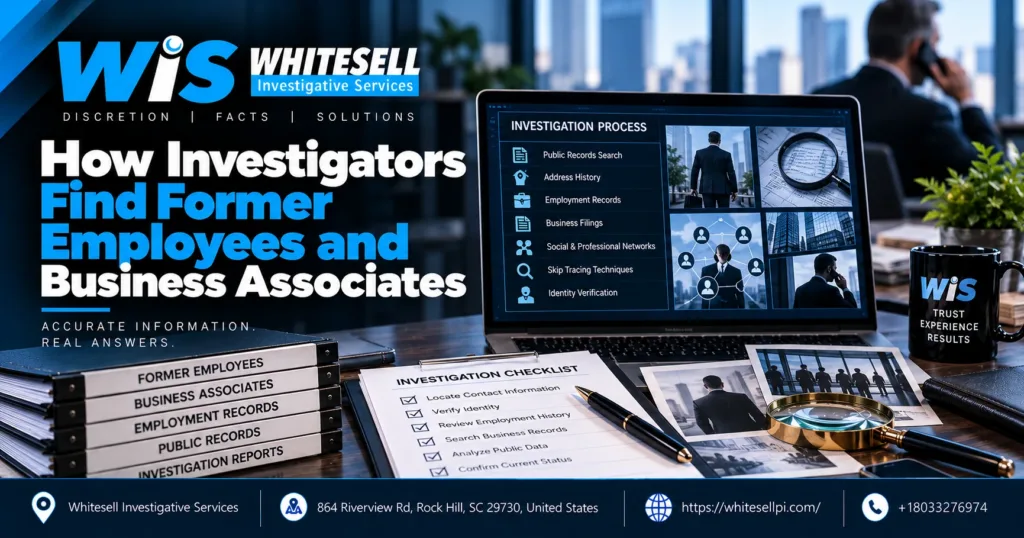
Investigators find former employees and business associates by combining identity verification, public records, professional history, address research, and lawful online sources. The goal is to locate a reliable current contact point while confirming that the person found is actually the individual connected to the business.
People change jobs, relocate, change names, close companies, and reduce their online presence. A professional search connects older information with current records, tests possible matches, and documents findings. This process helps businesses and attorneys reconnect with former contacts without relying on outdated directories, assumptions, or unverified information.
Why Do Former Employees and Business Associates Become Difficult to Find?
Former professional contacts become difficult to locate because information that was accurate during a business relationship can quickly become outdated.
An employee may change employers, move to another state, replace a telephone number, stop using an old email address, or change a surname. Business associates may sell companies, dissolve entities, retire, or begin operating through different organizations.
Time increases the difficulty. A personnel file containing an address from ten years ago may provide a starting point, but it should not be treated as a current location.
Common names create another challenge. Finding someone online with the correct first and last name does not establish that the person is the former employee being sought.
Investigators therefore work from identifiers rather than names alone. Previous addresses, employers, approximate age, professional licenses, business affiliations, known relatives, and other details can help distinguish the correct person from unrelated matches.
The objective is to establish a reasonable, documented connection between the former contact and current information.
What Records Can Help Locate a Former Professional Contact?
A professional search often starts with records already available to the business or attorney requesting assistance.
Old personnel information, contracts, correspondence, invoices, business cards, previous addresses, telephone numbers, email addresses, and known company affiliations can provide useful starting points.
Investigators can then compare those details with lawfully available records.
Property records may connect a person to a current or historical address. Corporate filings can identify business relationships. Professional licensing records may show a current practice location or employer. Court records can sometimes provide additional identifying information.
Historical records matter because locating someone often requires following a sequence rather than finding one current record immediately.
An old address may connect the subject to a property record. That record may reveal another address or associated individual. Additional research can then determine whether the new information belongs to the same person.
No single source is necessarily conclusive. Reliable searches compare several identifiers before treating a possible match as the former professional contact being sought.
How Do Investigators Confirm a Person’s Current Identity?
Identity confirmation is essential because inaccurate matches can create privacy problems, wasted effort, and unnecessary contact with unrelated people.
Investigators compare known information about the former employee or associate with information connected to the potential current identity.
Useful identifiers may include a full name, middle initial, approximate age, former addresses, previous employers, occupation, professional license, business interests, and known associates.
The more consistent identifiers available, the stronger the match becomes.
For example, finding a person with the correct name in another state may provide only a weak lead. If that person also previously lived at the known address, worked in the expected industry, and appears in records associated with the former employer, the identification becomes more credible.
Investigators should also look for contradictory information. A matching name may belong to someone of a different age, occupation, or geographic history.
Professional research attempts to resolve those conflicts before a current location or contact point is reported.
How Is a Current Location or Contact Point Verified?
Finding a possible address is different from verifying that the subject currently has a meaningful connection to it.
Investigators may compare multiple sources to determine whether an address appears current. Recent property information, professional records, corporate filings, public records, and other lawful sources can help establish continued association.
Telephone numbers and email addresses require similar caution.
Older databases can retain disconnected numbers or addresses long after a person stops using them. A contact point should therefore be evaluated against other available information whenever possible.
The level of verification needed depends on the purpose of the search. An attorney attempting to locate a potential witness may require greater confidence than a company trying to reconnect with a former vendor.
In some assignments, investigators may develop several possible contact points rather than one confirmed location.
A professional report should explain that distinction. Clearly identifying what is verified, what appears probable, and what remains unresolved allows the requesting party to decide how to proceed without overstating the investigation.
Can Employment and Business Records Support the Search?
Employment and business information can be particularly useful because professional relationships often leave records beyond a former employer’s internal files.
Corporate registrations may identify officers, managers, registered agents, or business addresses. Professional licensing databases can sometimes establish a person’s occupation and geographic connection.
A former employee may also become an owner, officer, consultant, or licensed professional after leaving the original company. Those later professional activities can provide a bridge between older employment information and current records.
Business names should be researched carefully.
A person may operate under a legal entity name that differs from the public-facing business name. Companies can also change names, merge, dissolve, or register in another jurisdiction.
Investigators may compare formation dates, addresses, officers, and other available information to determine whether a business record relates to the person being sought.
Employment research must still respect applicable privacy and access restrictions. The purpose is to use lawful information to establish professional connections, not to obtain protected personnel information improperly.
What Role Do Public Records and Online Sources Play?
Public records and online sources can provide valuable leads, but their reliability varies considerably.
Property records, corporate filings, court records, professional licenses, and other official sources can help establish addresses, business relationships, ownership interests, and historical connections.
Online professional profiles, company websites, archived pages, news reports, and other open sources can supplement that research.
Social media may provide clues about employment, geographic location, or professional relationships. However, a profile should not automatically be treated as verified simply because its name or photograph appears to match.
Investigators compare online information with stronger identifiers whenever possible.
Older online information can also remain visible long after circumstances change. A company biography may list someone who left years earlier. A directory may reproduce an address from an outdated database.
The value of online research comes from corroboration. Several independent sources pointing toward the same identity and location are generally more useful than a single unverified profile or directory entry.
What Privacy and Permissible-Purpose Limits Apply?
Locating a former employee or business associate does not provide unrestricted access to private information.
Investigators must work within applicable privacy laws, licensing requirements, database restrictions, and rules governing protected records. Certain information may be available only for authorized purposes or to qualified users.
The reason for the search matters.
A legitimate legal, business, investigative, or administrative purpose can shape which resources may appropriately be used. Investigators should understand the intended purpose before accessing restricted professional databases or requesting information.
Deception, unauthorized account access, hacking, and other improper methods are not acceptable substitutes for lawful research.
Sensitive information should also be handled carefully after it is obtained. A current home address or personal telephone number should not be distributed more broadly than necessary for the legitimate purpose of the assignment.
Professional investigators focus on obtaining useful information through permissible methods and reporting it to the authorized client in an appropriate manner.
What Are Common Business Reasons for Locating Former Contacts?
Businesses and attorneys may need to locate former employees or associates for many legitimate reasons.
A former employee may have knowledge relevant to litigation, an internal investigation, an insurance matter, a contract dispute, or a regulatory issue. Counsel may need to determine whether the person can be contacted as a potential witness.
Companies may also need former business associates to clarify historical transactions, agreements, ownership questions, or project records.
Executives, vendors, contractors, consultants, and former partners can possess information that is no longer available from current personnel.
Some searches involve administrative matters rather than disputes. A business may need to deliver documents, resolve an outstanding obligation, confirm historical information, or reconnect with someone concerning property or records.
The reason for locating the individual should be clearly defined before research begins.
A focused purpose helps investigators determine which information is relevant, which sources are appropriate, and how much verification is necessary before reporting a current contact point.
When Is Skip Tracing More Appropriate Than a General Search?
Skip tracing is generally appropriate when the primary objective is to locate a person’s current whereabouts or reliable contact information after ordinary methods have failed.
A general search may be sufficient when a company simply needs updated professional information and the person maintains an active public presence.
Skip tracing becomes more useful when the known address is old, telephone numbers are disconnected, mail is returned, or the individual has moved repeatedly.
It may also be appropriate when records contain several possible matches and additional research is needed to determine which one is correct.
Skip tracing typically works from historical identifiers and follows connections forward. Addresses, names, relatives, property, businesses, professional records, and other lawful information may be compared to develop a current lead.
The term does not imply unlimited investigative authority. The same privacy, access, and permissible-purpose requirements still apply.
The appropriate search method depends on why the person is being located and how much certainty the requesting party needs.
When Should a Professional Investigator Be Involved?
A professional investigator should be considered when routine searches produce outdated, conflicting, or uncertain information.
Professional assistance can also be valuable when the matter involves litigation, sensitive business concerns, multiple jurisdictions, common names, substantial time gaps, or a need for documented research.
The quality of the starting information affects the search.
Providing the investigator with the person’s full known name, former addresses, approximate age, prior employer, job title, telephone numbers, email addresses, business affiliations, and relevant dates can help narrow the research.
Investigators can then test potential matches against those identifiers rather than beginning with a name alone.
Professional involvement is especially useful when the client needs to know not only where someone may be located, but also how confidently the information can be connected to the correct person.
Clear documentation gives attorneys and businesses a more reliable basis for deciding whether and how to make contact.
FAQs
Can an investigator find someone using only an old work address?
An old work address can provide a starting point, especially when combined with a full name and employment history. Additional identifiers usually improve the ability to distinguish the correct person and develop current information.
Can investigators locate a former employee who moved to another state?
Yes, a search can extend across state lines when lawful records and reliable identifiers are available. Record access and available information vary by jurisdiction, so the scope of research may differ.
Can a former employee be found after changing their name?
Potentially. Investigators may compare historical addresses, professional records, business affiliations, court information, and other identifiers that connect an earlier identity with a current name.
Are social media profiles enough to verify someone’s location?
Usually not by themselves. Social media can provide useful leads, but profiles may be outdated, incomplete, private, or associated with another person. Important findings should be corroborated through additional sources when possible.
How long does it take to locate a former business associate?
The timeframe depends on the quality of the starting information, how long the person has been out of contact, name commonality, relocations, and the number of jurisdictions involved. Complex searches may require several stages of verification.
What information should a business provide before the search begins?
Useful details include the person’s full name, prior names, approximate age, former addresses, previous employer, position, telephone numbers, email addresses, business affiliations, and dates of contact. Accurate historical information can significantly narrow the search.
Key Takeaways
Finding a former employee or business associate requires more than entering a name into a database. Investigators compare historical identifiers, addresses, employment information, business records, public filings, and lawful online sources to locate and verify the correct person. Strong searches distinguish confirmed information from possible leads and account for name changes, relocations, and outdated records. Privacy and permissible-purpose requirements remain important throughout the process. Professional help becomes particularly useful when ordinary searches fail, legal matters are involved, or businesses need documented findings they can evaluate before making contact.
Reconnect With the Right Person Through Documented Research
When an important former contact cannot be located, accurate identification matters as much as finding a possible address. At Whitesell Investigation Services, we approach these searches by connecting historical information with current, lawfully available records and carefully checking whether the findings belong to the correct individual.
We can help businesses and legal professionals locate former employees, associates, witnesses, vendors, and other professional contacts when ordinary search methods are no longer enough. If you have reliable starting information but no current contact point, we can assess the available details and determine an appropriate investigative approach.