
How Expense Report Fraud Is Investigated
An unusual receipt or reimbursement request does not automatically prove an employee is committing fraud. Duplicate submissions can result from administrative errors, travel expenses can be categorized incorrectly, and legitimate purchases sometimes lack perfect documentation.
But when questionable expenses repeat, supporting documents appear altered, or reimbursement records consistently fail to match the underlying business activity, an expense report fraud investigation may be appropriate.
A proper investigation looks beyond a single suspicious transaction. It compares expense reports with receipts, payment records, company policies, travel information, approval history, and other available evidence to determine what can actually be established.
The objective should be fact-finding not starting with the assumption that an employee is guilty.
What Is Expense Report Fraud?
Expense report fraud generally involves intentionally seeking reimbursement from an employer for expenses that were not legitimate, were not incurred as represented, or were already reimbursed.
The issue can range from relatively small personal purchases submitted as business expenses to a recurring scheme involving falsified receipts or substantial reimbursements.
What makes an expense questionable depends partly on the company’s policies.
For example, a meal may be a legitimate reimbursable expense during approved business travel but not during an employee’s ordinary commute. A purchase might be allowed for one department but require preapproval for another.
That means investigators need to understand the organization’s reimbursement rules before deciding what a transaction indicates.
An investigation may look at questions such as:
- Was the expense actually incurred?
- Was it business-related?
- Was the amount accurately reported?
- Has the same expense already been reimbursed?
- Does the supporting document appear authentic?
- Did the employee follow required approval procedures?
- Do dates, locations, attendees, or transaction details match the employee’s explanation?
- Is the questionable claim isolated or part of a larger pattern?
An incorrect expense report is not necessarily fraudulent. Fraud generally involves intentional misrepresentation, which is why context and corroborating evidence matter.
What Are Common Expense Fraud Schemes?
Expense reimbursement systems can be vulnerable when employees are trusted to submit their own costs and managers approve them without consistently reviewing the supporting documentation.
Several patterns may warrant additional attention.
Duplicate reimbursement requests
An employee may submit the same expense more than once.
This can occur when the same receipt is included in separate reports, when a corporate-card purchase is also submitted for personal reimbursement, or when an expense is resubmitted months later.
Duplicate submissions can also happen accidentally, so matching transactions should be verified before conclusions are drawn.
Altered receipts
A receipt may be changed to show a different amount, date, merchant, description, or other information.
Digital receipts can sometimes be edited, while paper receipts may contain handwritten changes or missing information.
A questionable appearance alone does not establish alteration. Investigators may compare the document against payment records, merchant information, original electronic records, or other available sources.
Inflated expenses
An employee may incur a legitimate business expense but report a higher amount than was actually paid.
For example, a transportation expense, meal, lodging charge, or mileage reimbursement could be increased beyond the actual cost or authorized amount.
Personal purchases presented as business expenses
Personal meals, entertainment, travel, merchandise, subscriptions, or other purchases may be submitted as if they were business-related.
The investigation needs to consider both the nature of the transaction and the company’s reimbursement rules.
False or fabricated expenses
In a more serious situation, an employee may seek reimbursement for something that never occurred.
A fabricated claim could involve a nonexistent meal, invented mileage, false lodging expense, or documentation created to support a purchase that was never made.
Mischaracterized expenses
The transaction itself may be real, but the employee may describe its purpose inaccurately to qualify for reimbursement or avoid additional scrutiny.
For example, an employee could identify a personal meeting as a client meeting or claim an expense involved several business attendees when it did not.
Splitting expenses to avoid approval limits
A company may require higher-level approval for expenses above a particular amount.
Several smaller transactions submitted instead of one larger expense may warrant review when the pattern appears designed to avoid that control.
None of these indicators should be viewed in isolation. An investigation should establish whether the records and surrounding circumstances support a reasonable explanation.
What Patterns Can Appear in Receipts and Expense Reports?
One questionable receipt may tell an employer very little. Patterns across multiple reports can provide more useful information.
Investigators may compare transactions across weeks, months, employees, departments, or vendors to identify recurring activity.
Potential patterns can include:
- Multiple submissions of the same receipt
- Identical amounts appearing repeatedly
- Expenses consistently just below approval thresholds
- Receipts with missing or inconsistent transaction details
- Purchases occurring on dates when the employee was not traveling
- Mileage claims that do not reasonably correspond with reported destinations
- Business meals without identifiable business purposes or attendees
- Transactions at unusual times or locations
- Expenses inconsistent with the employee’s normal responsibilities
- Corporate-card purchases that also appear on reimbursement reports
- Sequential or unusually similar receipt documentation
- Frequent claims from the same merchant
- Expenses submitted long after they were supposedly incurred
- Repeated missing-receipt declarations
- Supporting records that conflict with calendars, travel itineraries, or other company information
Patterns require interpretation.
An employee who travels frequently may naturally submit similar hotel or meal amounts. An executive entertaining clients may have legitimate expenses that would appear unusual for another employee.
The investigator should therefore compare reimbursement activity with the person’s job duties, travel schedule, company policy, and available supporting records rather than treating statistical irregularities as proof of misconduct.
How Is Expense Report Fraud Investigated?
An expense report fraud investigation usually begins by defining the specific concern and preserving the records relevant to it.
The investigation can then expand if the evidence indicates that additional transactions or individuals need review.
1. Define the allegation
A useful starting question might be:
“Did this employee knowingly submit duplicate or personal expenses for reimbursement between January and June?”
That is more useful than simply asking an investigator to determine whether the employee is stealing.
A defined question helps determine which records matter and prevents the investigation from becoming unnecessarily broad.
2. Review the reimbursement policy
Before evaluating individual transactions, investigators should understand what the company allows.
Relevant policies may address:
- Approved expense categories
- Documentation requirements
- Mileage reimbursement
- Travel and lodging
- Meals and entertainment
- Corporate-card use
- Personal purchases
- Approval limits
- Missing receipts
- Submission deadlines
- Manager responsibilities
A transaction that appears questionable may turn out to be permitted under the company’s existing policy.
3. Gather relevant records
Depending on the allegation, useful documents can include:
- Expense reports
- Original or submitted receipts
- Corporate-card statements
- Bank or payment records available to the company
- Reimbursement records
- Travel bookings
- Hotel documentation
- Calendar entries
- Mileage records
- Purchase approvals
- Accounting-system data
- Emails
- Relevant workplace messages
- Vendor records
- Manager approvals
- Prior audit findings
The investigator can organize these records into a timeline or transaction schedule to make inconsistencies easier to identify.
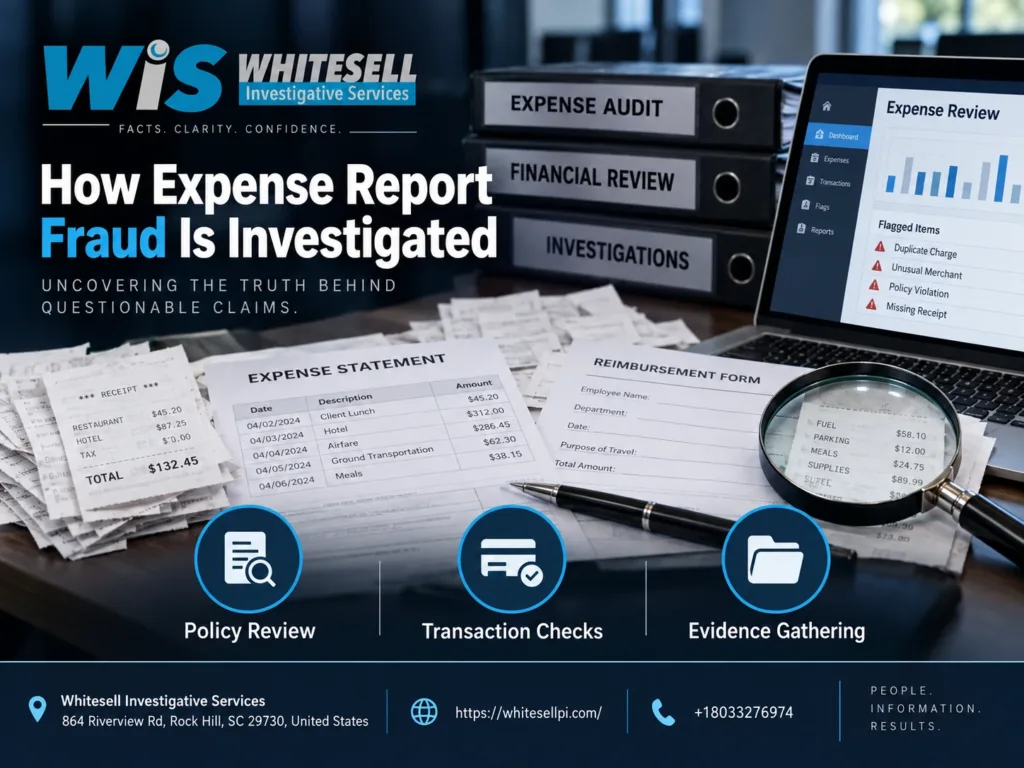
4. Compare transactions and supporting evidence
The next step is to compare what the employee reported with other available information.
A hotel reimbursement, for example, might be compared against travel records, corporate-card transactions, dates of business meetings, and the submitted hotel documentation.
If the same amount appears twice, investigators can determine whether there were actually two transactions or one transaction submitted twice.
5. Look for broader patterns
Once one unsupported claim is identified, it may be reasonable to review similar transactions from the same period.
However, the scope should remain proportionate.
The discovery of one accounting error does not necessarily justify an unrestricted examination of every aspect of an employee’s personal or professional life.
6. Conduct interviews
Interviews can provide explanations that documents cannot.
Depending on the case, investigators may speak with:
- The employee who submitted the expense
- Supervisors
- Finance or accounting personnel
- Administrative staff
- Employees listed as meal attendees
- Other relevant witnesses
The employee should have an opportunity to explain discrepancies where appropriate.
For example, two similar receipts may represent separate legitimate transactions. A missing approval may reflect a manager’s administrative error rather than an attempt by the employee to conceal the purchase.
Investigators should compare interview statements against the documentary evidence instead of automatically accepting or rejecting an explanation.
7. Document the findings
The final investigative report should make clear:
- What allegation was investigated
- Which records were reviewed
- Which interviews were conducted
- What facts were established
- Which explanations were corroborated
- Which discrepancies remain unresolved
- Whether additional investigative work may be useful
The investigator should avoid reaching conclusions that extend beyond what the evidence supports.
Why Is Evidence Preservation Important?
Expense investigations can become difficult when records are deleted, overwritten, changed, or scattered among multiple systems.
Businesses should therefore preserve potentially relevant information once a significant concern is identified.
That may include:
- Original expense reports
- Submitted receipt files
- Accounting records
- Corporate-card statements
- Approval history
- Relevant emails and messages
- Travel records
- Digital files and attachments
- Audit logs where available
- Company-issued devices when relevant
- Records showing later changes to expense submissions
Preservation is especially important with digital evidence.
Opening, editing, resaving, exporting, or deleting files can sometimes alter information associated with them. Businesses should avoid unnecessary modification of potentially important records and consider appropriate IT, legal, or forensic guidance when electronic evidence may become significant.
Preserve originals where practicable
A screenshot of a receipt or accounting entry may be useful for reference, but it should not necessarily replace the underlying record.
Keeping original electronic files and system information may provide additional context later.
Document who collected the information
Businesses should keep a basic record of:
- Who obtained the evidence
- When it was collected
- Where it came from
- Where it was stored
- Who later accessed or received it
This can make the investigation easier to explain and reduces questions about how key records were handled.
Preserving evidence does not guarantee a particular legal outcome or establish that an expense was fraudulent. It simply protects the information needed for a reliable review.
When Does Suspected Expense Fraud Justify an Investigation?
Not every reimbursement mistake requires a private investigator.
An isolated arithmetic error or missing receipt may be handled appropriately through normal accounting or HR procedures.
A more formal investigation may be justified when the concern becomes recurring, financially significant, difficult to explain, or potentially intentional.
Examples include situations where:
- Duplicate reimbursements appear repeatedly
- Receipts appear altered or fabricated
- Corporate-card and reimbursement records overlap
- Personal purchases are repeatedly categorized as business expenses
- A significant amount of money is involved
- The employee’s explanation conflicts with available records
- Several employees may be involved
- Managers or executives are part of the allegation
- Accounting staff cannot independently resolve the discrepancies
- The company suspects a broader internal theft issue
- Digital records require specialized review
- An independent investigation would provide greater neutrality
- Litigation, termination, insurance, or law-enforcement considerations may arise
The decision should be based on the seriousness and complexity of the unexplained activity rather than simply the number of unusual transactions.
When outside investigative support can help
Internal accounting teams are often well positioned to detect expense irregularities. They may not always be positioned to investigate the people, relationships, interviews, records, or broader conduct connected with those irregularities.
That is where a corporate investigator may become useful.
An investigator can work from a defined allegation, organize evidence, develop timelines, conduct appropriate interviews, identify corroborating information, and report what the available facts establish.
Whitesell Investigative Services’ Internal Theft page is the appropriate primary internal link when recurring reimbursement losses raise a broader concern about employee theft or misuse of company assets.
If the inquiry expands into accounting discrepancies, multiple employees, fraud concerns, business relationships, or other organizational issues, the Corporate Investigations page provides the related internal link.
For businesses in Rock Hill and surrounding areas, local investigative support may also be useful when a matter requires interviews, records research, field investigation, or coordination with company personnel in the area.
FAQs
What is expense report fraud?
Expense report fraud generally involves intentionally submitting false, inflated, duplicate, altered, personal, or otherwise improper expenses for reimbursement. A mistake or policy violation does not automatically establish fraud, so the surrounding facts and intent should be investigated carefully.
What are the most common warning signs of expense reimbursement fraud?
Potential indicators include duplicate receipts, altered documentation, repeated missing receipts, expenses just below approval limits, personal purchases categorized as business costs, conflicting travel records, and overlapping corporate-card and reimbursement claims. These are reasons for additional review rather than proof of fraud.
How can a company investigate suspicious receipts?
The company may compare receipts with expense reports, accounting data, corporate-card statements, travel information, approval history, calendars, and other relevant records. Interviews may also be used to clarify discrepancies or establish how a transaction occurred.
Should an employee be interviewed during an expense fraud investigation?
Often, yes. An employee’s explanation can provide important context and may resolve apparent inconsistencies. The timing and manner of the interview should depend on the investigation, company procedures, and any guidance from HR or legal counsel.
Should companies preserve original expense records?
Yes. When a significant investigation is possible, preserving original reports, receipts, electronic files, accounting records, approvals, and related communications can help maintain a reliable factual record.
Does a suspicious expense automatically justify hiring a private investigator?
No. Routine errors may be handled internally. Professional investigative assistance becomes more relevant when questionable reimbursements are recurring, financially significant, disputed, involve senior personnel, or require independent fact-finding beyond what internal accounting or HR teams can reasonably perform.
Establish the Pattern Before Drawing the Conclusion
Expense reimbursement problems often begin with something small: a repeated receipt, an unexplained charge, a questionable mileage claim, or a transaction that does not match the employee’s travel schedule.
The important next step is not to assume fraud. It is to determine whether the inconsistency has a reasonable explanation and whether the same issue appears elsewhere.
A careful expense report fraud investigation can connect reimbursement records, receipts, approvals, financial information, interviews, and other evidence into a clearer account of what happened.
Whitesell Investigative Services works with businesses on internal theft and corporate investigative matters in Rock Hill and surrounding service areas. When unexplained reimbursements become recurring, financially significant, or difficult to resolve internally, our team can discuss the circumstances and whether an independent investigation would be an appropriate next step.