
Hotel Room and Rental Property Bug Sweeps: What Travelers Should Know
Travelers concerned about privacy in hotels or rental properties can perform basic visual checks, but they should avoid dismantling fixtures, handling suspicious electronics, or assuming every unfamiliar device is surveillance equipment. A professional TSCM bug sweep becomes appropriate when there is a credible reason to suspect unauthorized monitoring or when highly sensitive activities justify additional precautions.
Temporary accommodations contain cameras, sensors, routers, televisions, chargers, and other legitimate electronics. Understanding what belongs in the space, recognizing unusual conditions, preserving suspicious findings, and responding calmly can protect privacy without turning normal travel into constant surveillance concerns.
What Privacy Risks Can Exist in Hotels and Rental Properties?
Hotels and short-term rentals create different privacy conditions from a home or controlled office because many people may have access to the property.
Staff, cleaners, maintenance workers, contractors, property owners, previous guests, and other authorized individuals may enter temporary accommodations at different times.
Most properties operate legitimately. The presence of electronic equipment does not mean unauthorized surveillance exists.
Privacy concerns can arise when recording equipment is concealed where guests reasonably expect privacy or when unfamiliar devices appear inconsistent with the normal purpose of the room.
Travelers conducting sensitive business also face broader risks. Confidential conversations, documents, laptops, mobile devices, and online communications can expose information even without a hidden microphone or camera.
The appropriate response is proportional awareness.
Travelers should understand their surroundings, protect sensitive information, and investigate genuinely unusual conditions without treating every smoke detector, router, sensor, or charger as suspicious.
When circumstances provide a credible reason for concern, professional assessment offers a more reliable approach than speculation.
What Safe Visual Checks Can Travelers Make?
A traveler can begin with a simple visual inspection without opening, dismantling, or damaging anything.
Look around the room as it currently exists. Identify obvious electronics, cameras disclosed by the property, routers, smart televisions, speakers, alarm systems, and other connected equipment.
Notice whether an object appears inconsistent with its location or purpose.
An unfamiliar electronic device positioned unusually close to a bed, bathroom, changing area, desk, or private meeting space may justify questions.
Travelers can also look for visible damage, unexplained openings, unusual cables, or equipment that appears recently altered.
A visual check should remain non-invasive.
Do not remove outlet covers, open smoke detectors, dismantle clocks, disconnect building systems, or damage property while searching for hidden equipment.
If something appears unusual, photograph it in place when doing so is safe.
Ask property management what the item is if that can be done without compromising a serious concern.
A safe visual check is intended to identify obvious anomalies, not perform a professional technical inspection.
Where Should Travelers Pay Extra Attention in Temporary Accommodations?
Travelers should focus attention on areas where privacy expectations are highest or where sensitive conversations will occur.
Bedrooms, bathrooms, changing areas, private workspaces, and meeting areas deserve reasonable visual awareness.
Objects with a direct view of those spaces may naturally attract attention. However, many legitimate devices are positioned throughout modern accommodations.
Hotels may use smoke detectors, occupancy sensors, thermostats, televisions, access systems, telephones, and networking equipment. Rental properties may also contain smart-home devices, security equipment, speakers, and automated controls.
The important question is whether the equipment has a legitimate purpose and whether its placement is consistent with that purpose.
Business travelers should also consider where confidential conversations happen.
A hotel suite used for negotiations or legal discussions creates different privacy concerns from a room used only for sleeping.
Avoid conducting highly sensitive conversations in spaces you cannot reasonably control when alternatives are available.
Attention should be based on context, not an exhaustive search of every object. Unusual placement, unexplained modifications, or credible prior concerns deserve more scrutiny.
Why Are Consumer Bug Detector Apps Limited?
Consumer applications cannot transform an ordinary smartphone into the full range of specialized equipment used during professional TSCM work.
Some applications display nearby wireless networks, Bluetooth devices, magnetic readings, or other information available through the phone’s existing sensors.
That information can be misunderstood.
Hotels and rental properties commonly contain many wireless devices. Nearby rooms, routers, televisions, speakers, phones, wearables, and building systems can produce signals without presenting a surveillance threat.
An application may identify activity without establishing its source, purpose, or location.
It may also fail to identify equipment that does not communicate through the technology being measured.
Professional surveillance detection involves more than finding a signal.
TSCM specialists evaluate the physical environment, known electronics, radio-frequency activity, suspicious components, and other technical indicators using multiple methods.
Travelers should therefore avoid treating an application’s alert as proof that a room contains a hidden device.
Apps may provide limited observations, but suspicious findings still require verification before conclusions are justified.
Can Unusual Devices or Wiring Be a Warning Sign?
Unusual electronics, wiring, adapters, or physical modifications can justify closer attention, especially when nobody responsible for the property can explain them.
A device may deserve scrutiny when its placement does not match an obvious function or when it appears modified, concealed, or directed toward a sensitive area.
Unexpected cables or recently disturbed fixtures can also raise questions.
However, being unfamiliar does not mean being malicious.
Modern properties contain networking hardware, environmental sensors, television equipment, charging systems, security components, smart-home controls, and maintenance devices that guests may not recognize.
Avoid making accusations based on appearance alone.
Document the object and its location. If appropriate, ask management or the property owner to identify it.
When the explanation is inconsistent, the object appears deliberately concealed, or other credible concerns exist, consider leaving the area and obtaining professional guidance.
Do not plug unknown electronics into your devices, connect to unfamiliar hardware, or experiment with suspected equipment.
Preserving its existing condition may become important if further investigation is required.
When Is a Professional Bug Sweep Justified?
A professional bug sweep is most justified when there is a credible surveillance concern or when the sensitivity of planned activities warrants additional protection.
An executive traveling for confidential negotiations may have a different risk profile from a vacation traveler with no specific threat indicators.
Professional assessment may be appropriate after suspicious access, unexplained information leaks, previous surveillance concerns, unusual physical findings, or credible threats.
It may also be considered before highly sensitive meetings involving litigation, acquisitions, intellectual property, financial negotiations, or other valuable confidential information.
One strange electronic sound or unfamiliar device does not automatically justify a full TSCM inspection.
Start with context.
Consider what information could be targeted, who might benefit from obtaining it, who has had access to the location, and whether multiple warning signs support the concern.
A professional can discuss these circumstances before determining whether a sweep is warranted.
Risk-based decisions help travelers protect privacy without treating ordinary temporary accommodations as inherently unsafe.
What Can a TSCM Professional Check That Travelers Cannot?
A TSCM professional can conduct a structured technical assessment using specialized equipment, established inspection procedures, and experience interpreting electronic environments.
The process may include physical inspection and evaluation of radio-frequency activity across relevant ranges.
Depending on the assignment, additional techniques may help identify electronic components that are not actively transmitting during the inspection.
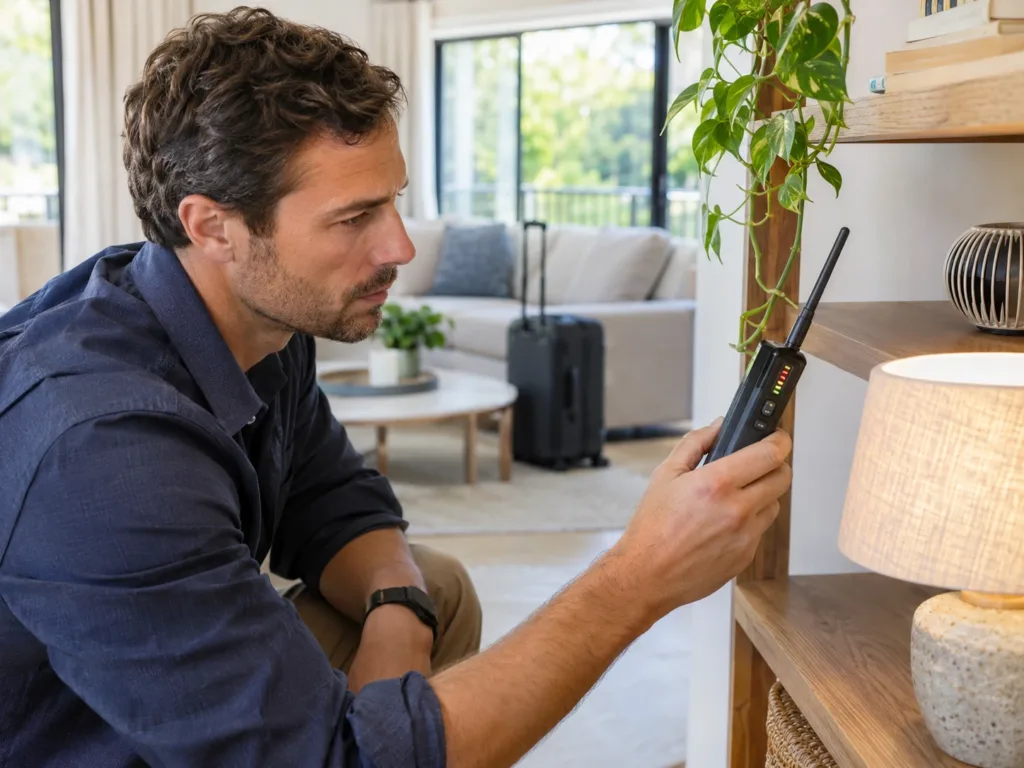
Distinguishing Normal Signals
Temporary accommodations can contain substantial wireless activity. Professional analysis helps distinguish expected signals from anomalies requiring investigation.
Evaluating Physical Conditions
A trained examiner can assess suspicious fixtures, wiring, electronics, communications equipment, and other relevant infrastructure without relying solely on appearance.
Correlating Multiple Findings
One unusual signal or object rarely tells the entire story.
TSCM work compares technical observations with physical conditions, known equipment, access history, and the client’s specific concerns.
No professional method can guarantee detection of every possible surveillance technique.
The value of TSCM comes from systematic examination, specialized tools, informed interpretation, and clear documentation of findings and limitations.
What Should You Do If You Find a Suspicious Device?
If you discover something that reasonably appears to be unauthorized surveillance equipment, avoid unnecessary handling.
Photograph the object in its original location when it is safe to do so. Record the date, approximate time, room, and circumstances of the discovery.
Do not immediately dismantle the item to determine how it works.
Removing batteries, disconnecting wires, opening housings, or pressing controls can alter its condition and potentially affect useful evidence.
If you feel unsafe, leave the location and move to a secure place.
Contact property management when appropriate. Depending on the circumstances, you may also need to contact the booking platform, legal counsel, corporate security, or law enforcement.
Avoid confronting a suspected responsible person yourself.
A suspicious device does not automatically establish who installed it, when it was installed, or whether a particular person knew about it.
Focus on personal safety, factual documentation, and appropriate reporting.
Professional evaluation can help determine what the object actually is before broader conclusions are made.
How Should Potential Evidence Be Preserved?
Potential evidence should remain as close as possible to the condition in which it was discovered.
Avoid touching, moving, disconnecting, opening, or testing a suspicious device unless safety or appropriate authorities require otherwise.
Take photographs from a reasonable distance and record the surrounding area.
Document the room number or property location, date, time, and how the item was noticed. Write down who was present and whether anyone handled the object afterward.
Preserve relevant communications as well.
Booking records, messages with the host or hotel, photographs of the room, and correspondence concerning the discovery may provide useful context.
Do not delete original files after sending copies.
If law enforcement becomes involved, follow its instructions regarding the device and location.
Businesses may also involve legal counsel or security personnel when an employee discovers suspected surveillance during corporate travel.
Good preservation focuses on facts.
Avoid modifying the scene or creating assumptions about ownership and intent. Accurate documentation allows qualified professionals to evaluate what happened.
How Can Travelers Reduce Privacy Risks Without Becoming Overly Alarmed?
Reasonable privacy awareness should improve travel security without making every unfamiliar environment seem threatening.
Begin with ordinary precautions.
Know what electronics are present, protect your devices, use approved communication methods for sensitive business, and avoid discussing highly confidential information in uncontrolled public areas.
Keep laptops and documents secured when they are unattended.
Use property safes only according to your organization’s security policies and the sensitivity of the material involved.
Business travelers should consider whether a hotel room is appropriate for confidential meetings at all.
A controlled office or professionally secured meeting location may be preferable for particularly sensitive discussions.
Perform simple visual observations without dismantling property.
If something looks unusual, seek an explanation and document it rather than immediately assuming surveillance.
Escalate when the facts justify escalation.
Credible threats, unexplained disclosures, suspicious equipment, or high-risk business circumstances may warrant professional assistance.
The objective is practical privacy protection based on evidence and risk, not constant suspicion.
FAQs
Are hidden cameras allowed in hotel rooms or rental bedrooms?
Rules vary by jurisdiction and platform, but private spaces can carry significant legal and policy protections. If you discover suspected concealed recording equipment, document the situation and consider contacting management, the booking platform, law enforcement, or legal counsel as appropriate.
Can my phone reliably detect a hidden camera?
A phone may provide limited observations through available sensors or network information, but it cannot reliably identify every concealed camera. Professional evaluation uses broader methods and still requires careful interpretation.
Should I unplug every unfamiliar device in a rental?
No. The property may contain legitimate routers, sensors, alarms, smart-home equipment, or other necessary devices. If something appears suspicious, document it and seek clarification rather than automatically disconnecting equipment.
Can a professional sweep guarantee that a room is completely surveillance-free?
No responsible provider can guarantee detection of every surveillance method under every condition. A professional TSCM assessment evaluates the environment within a defined scope and explains significant findings and limitations.
Should I confront a host if I discover a suspicious device?
Avoid confrontation when you feel unsafe or when the nature of the device is uncertain. Move to a secure location and document the situation. Appropriate next steps may include contacting property management, the booking platform, corporate security, or law enforcement.
When should a business traveler request a TSCM inspection?
Professional assessment may be appropriate when credible surveillance concerns exist or when highly sensitive meetings justify additional precautions. The decision should consider the value of the information, access to the location, known threats, and previous security incidents.
Key Takeaways
Travelers can reduce privacy risks in hotels and rental properties by staying observant, protecting sensitive information, and responding proportionately to unusual conditions. Basic visual checks can identify obvious concerns, but consumer apps and unfamiliar electronics do not provide reliable proof of surveillance. Avoid dismantling suspicious devices or altering potential evidence. Document unusual findings, preserve original records, and seek appropriate professional or law enforcement guidance when circumstances justify it. TSCM professionals can perform deeper physical and technical assessments, but no sweep guarantees permanent protection. Effective travel privacy combines awareness, secure behavior, documentation, and risk-based decisions.
Make Privacy Part of Sensitive Travel Planning
Travel privacy concerns should be evaluated carefully, especially when temporary accommodations are being used for executive work, legal discussions, negotiations, or other confidential activity. At Whitesell Investigation Services, we approach TSCM concerns by assessing the circumstances, identifying relevant risks, and determining whether professional technical inspection is appropriate.
We can help travelers, executives, businesses, and their advisors evaluate credible surveillance concerns in temporary environments. When a hotel, rental property, or meeting location presents specific warning signs or will be used for sensitive activity, we can discuss the situation discreetly and help determine an appropriate next step.