
Time Theft vs. Payroll Fraud: What Employers Need to Know
Time theft involves employees receiving pay for time they did not actually work, while payroll fraud involves intentional manipulation of payroll systems, records, compensation, or employee information for improper financial gain. Both can increase labor costs, distort business records, and require careful investigation.
Employers should respond by verifying discrepancies before assuming misconduct. Timekeeping records, payroll data, access logs, schedules, policies, interviews, and other documentation can help establish what occurred. The appropriate response depends on the conduct, available evidence, financial impact, frequency, and whether an internal review can resolve the issue fairly.
What Is Time Theft?
Time theft generally occurs when an employee is compensated for working time that was not actually worked. The specific circumstances can vary considerably between workplaces, schedules, timekeeping systems, and employment arrangements.
Examples may include recording an inaccurate starting time, remaining clocked in after work has stopped, having another employee record attendance, or intentionally reporting hours that were not worked.
Employers should distinguish intentional misconduct from ordinary mistakes.
An incorrect time entry can result from a forgotten clock-out, system problem, misunderstanding, supervisor correction, or administrative error. One discrepancy should not automatically be characterized as theft.
Patterns provide more useful information.
Repeated discrepancies involving the same types of entries, shifts, employees, or approval processes may justify closer review. Employers can compare time records with schedules, workplace access information, assignments, and other appropriate documentation.
The objective should be determining what occurred before deciding why it occurred or what response is justified.
What Is Payroll Fraud?
Payroll fraud generally involves intentional manipulation of payroll information or processes to obtain compensation or other financial benefits improperly.
Unlike ordinary timekeeping discrepancies, payroll fraud can involve broader control over employee records, compensation calculations, payment instructions, reimbursements, deductions, or payroll administration.
The exact method depends on the organization’s payroll system and internal controls.
Potential concerns might include unauthorized changes to compensation, improper payments, fabricated employee information, manipulated overtime, false expense information connected with payroll, or diversion of payments.
Not every payroll discrepancy indicates fraud.
Software errors, incorrect employee classifications, duplicate data entry, misunderstood policies, tax adjustments, or administrative mistakes can produce unusual payroll results without intentional misconduct.
Employers should first identify the questionable transaction and determine how it entered the payroll process.
A structured review can establish who created, changed, approved, or processed relevant information and whether supporting documentation exists.
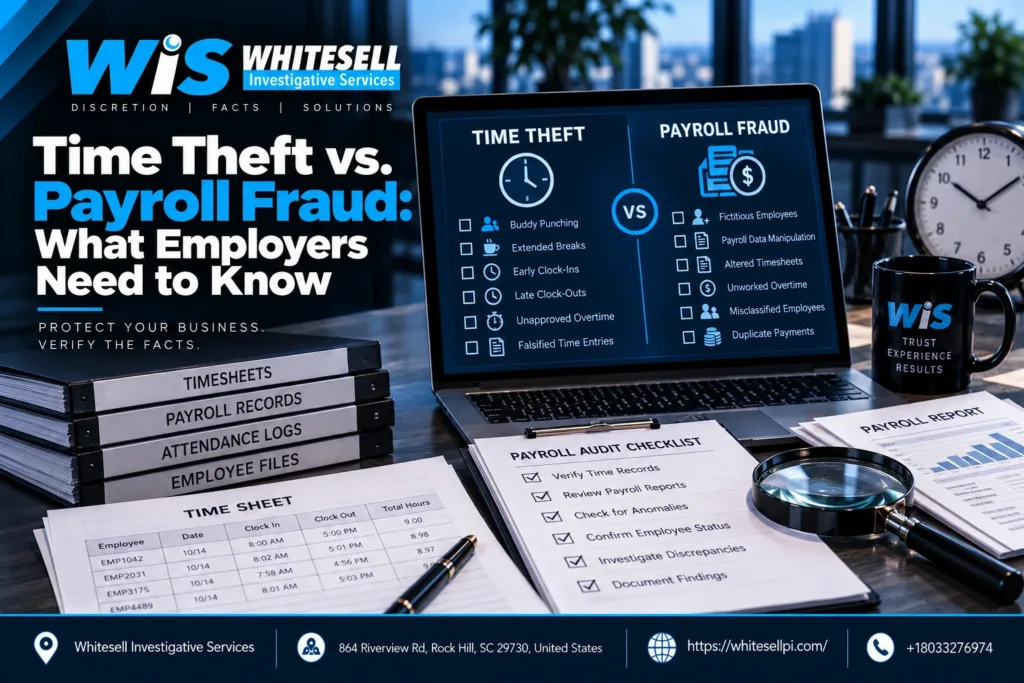
Time Theft vs Payroll Fraud: What Is the Difference?
The primary difference between time theft and payroll fraud is the type of information being manipulated and how improper compensation may be obtained.
Time theft usually centers on paid working time. The concern is whether recorded hours accurately reflect hours actually worked under applicable workplace policies and requirements.
Payroll fraud can be broader.
It may involve manipulating employee records, compensation rates, payment details, reimbursements, overtime, deductions, or other elements of payroll processing.
The two issues can overlap.
For example, deliberately submitting hours that were never worked could create both a timekeeping concern and an improper payroll payment. How an employer categorizes conduct may depend on the facts, company policies, applicable law, and advice from appropriate professionals.
Employers should avoid becoming overly focused on labels during the early investigation.
The more important questions are what records were changed, who had access, whether the information was accurate, what payments resulted, and whether evidence supports intentional conduct.
What Are the Most Common Time Theft Schemes?
Time theft concerns often involve inaccurate reporting of when an employee started, stopped, or performed work.
One commonly discussed practice is buddy punching, where one worker records time for another employee who is not actually present.
Other concerns may involve intentionally clocking in before work begins, remaining clocked in after work ends, recording hours for missed shifts, or submitting inaccurate manual timesheets.
Remote and mobile work can create different questions because physical presence may not establish whether assigned work occurred.
Employers should avoid relying on assumptions about productivity alone. Job duties, authorized breaks, flexible schedules, travel, off-site assignments, and technical problems can affect what records appear to show.
Why do patterns matter?
Repeated discrepancies can be more informative than one questionable entry.
Investigators may compare multiple pay periods to determine whether similar entries recur at predictable times or under similar circumstances.
Any review should account for legitimate corrections and authorized schedule changes before treating differences as evidence of intentional time theft.
What Are the Most Common Payroll Fraud Schemes?
Payroll fraud can involve several types of intentional manipulation, depending on who has access to payroll systems and approval processes.
Potential schemes include creating payments for nonexistent or unauthorized workers, changing compensation without authorization, manipulating overtime, diverting payments, or processing improper reimbursements.
Another concern can arise when inactive employees remain in payroll systems and payments continue without a legitimate basis.
Unauthorized changes to direct deposit information can also require investigation, although businesses should distinguish internal misconduct from external account compromise or cybercrime.
Payroll fraud sometimes depends on weak separation of duties.
If one person can create employee records, change compensation, approve adjustments, and process payments without independent review, inappropriate transactions may be harder to detect.
Employers should examine the transaction rather than assume a particular scheme occurred.
Audit trails, approval records, payroll reports, bank information, and supporting documentation can help establish how a questionable payment was generated.
What Evidence Can Employers Review?
Employers should begin with records directly connected to the suspected discrepancy.
Relevant evidence may include timesheets, payroll reports, schedules, approval histories, employee records, overtime submissions, system audit trails, and documented corrections.
Accessing information can sometimes provide additional context.
Badge records, authorized login histories, building access records, work assignments, or other business records may help establish a timeline when their use is appropriate and lawful.
Employers can also review relevant policies and procedures.
A timekeeping practice cannot be evaluated properly without understanding how employees were instructed to record hours, obtain approvals, report corrections, or document remote work.
Evidence should be preserved before records are routinely overwritten or deleted.
Investigators should distinguish original records from summaries created during the review. They should also document where information originated and how it relates to the suspected discrepancy.
No single record should automatically determine responsibility when other reasonable explanations remain.
When Is an Internal HR Review Enough?
An internal human resources review may be sufficient when the issue is limited, records are straightforward, and there is no significant dispute about what occurred.
For example, HR may be able to resolve an isolated timekeeping discrepancy by reviewing the employee’s schedule, time entry, supervisor approval, and explanation.
Administrative mistakes can often be corrected without a formal investigation.
HR may also be well positioned to determine whether existing policies were followed and whether additional training or procedural clarification is necessary.
More complex circumstances can require additional support.
Concerns involving significant financial losses, multiple employees, management personnel, conflicting evidence, repeated patterns, or possible manipulation of payroll systems may exceed the practical scope of a routine HR review.
Employers should also consider whether internal relationships could affect perceived independence.
The decision should depend on complexity and risk rather than automatically escalating every discrepancy into a formal investigation.
When Should an Employer Consider a Formal Investigation?
A formal investigation may be appropriate when available information suggests substantial, repeated, coordinated, or intentionally concealed discrepancies.
Recurring losses can be especially important when ordinary administrative review has not identified a satisfactory explanation.
Employers may also consider independent investigation when multiple departments, employees, supervisors, contractors, or payroll administrators could be involved.
A defined investigative scope is essential.
Before work begins, the employer should identify the questions requiring answers, relevant periods, systems involved, and records that need preservation.
Formal investigation does not mean guilt has already been established.
The purpose is to gather facts objectively and determine whether evidence supports or contradicts the initial concern.
Legal counsel, HR professionals, accountants, insurers, or law enforcement may also have roles depending on the circumstances.
An investigator should remain within the authorized scope and avoid making employment or legal decisions that belong to other professionals.
How Are Time Theft and Payroll Fraud Investigations Conducted?
Investigations generally begin by defining the suspected discrepancy and preserving relevant records.
Investigators may review payroll reports, timekeeping data, schedules, audit trails, access records, approval histories, policies, and other appropriate documentation.
The next step is often chronology.
A timeline can identify when questionable entries occurred, who had system access, when changes were approved, and when payments were processed.
Patterns can then be compared across relevant periods.
How do interviews support the investigation?
Interviews can clarify procedures, responsibilities, system access, disputed transactions, and explanations for discrepancies.
Investigators should prepare questions using information already established through records. Statements can then be compared with independently available documentation.
Interviews should remain professional and fact focused.
Investigators should not mischaracterize evidence or assume that inconsistent recollection automatically proves intentional misconduct.
The final report should clearly distinguish verified records, interview statements, analytical findings, and unresolved questions.
That structure allows decision-makers to evaluate the evidence without depending on unsupported conclusions.
How Can Employers Reduce Future Payroll and Timekeeping Losses?
Prevention begins with clear procedures and appropriate internal controls.
Employees should understand how to record working time, request corrections, obtain overtime approval, and report timekeeping problems.
Payroll permissions should also be reviewed regularly.
Organizations can limit sensitive system access according to job responsibilities and remove access promptly when roles change.
Separation of duties provides another safeguard.
Where practical, the person creating or changing payroll information should not have unrestricted authority to approve and process the same transactions without review.
Periodic audits can identify unusual patterns before losses become substantial.
Employers may review manual adjustments, repeated corrections, overtime patterns, inactive employees, unusual payment changes, and other exceptions relevant to their operations.
Controls should not assume employees are dishonest.
Effective systems create reliable records, reduce opportunities for mistakes, and make intentional manipulation easier to identify if it occurs.
FAQs
Is time theft the same as payroll fraud?
No. Time theft generally concerns receiving compensation for time not worked, while payroll fraud can involve broader manipulation of payroll records or payments. The issues may overlap in some circumstances.
How can an employer prove time theft?
Employers should establish facts through reliable records rather than assumptions. Time entries may be compared with schedules, authorized access information, assignments, approvals, interviews, and other relevant evidence.
Can payroll errors look like fraud?
Yes. Administrative mistakes, system problems, incorrect approvals, duplicate entries, or misunderstood procedures can create suspicious discrepancies. Employers should determine how an error occurred before concluding it was intentional.
Should employees be interviewed during an investigation?
Interviews may help clarify discrepancies, procedures, responsibilities, and relevant events. Investigators should compare statements with available records and avoid treating an interview alone as proof of misconduct.
What records should be preserved when payroll fraud is suspected?
Relevant records may include payroll reports, timekeeping data, approval histories, audit trails, schedules, employee records, payment information, policies, and supporting documents. The appropriate evidence depends on the suspected conduct.
Can a private investigator investigate suspected payroll fraud?
A qualified investigator may assist with factual investigation within the lawful and authorized scope of an assignment. Employers may also need HR, legal, accounting, cybersecurity, insurance, or law enforcement assistance depending on the circumstances.
Establishing the Facts Before Making a Decision
Timekeeping and payroll discrepancies can create financial concerns, but employers need reliable facts before deciding that intentional misconduct occurred. At Whitesell Investigation Services, we approach these matters by identifying the questions that require answers, reviewing relevant documentation, establishing timelines, and objectively reporting what the evidence supports.
We can assist when suspected time theft or payroll fraud has become too complex, sensitive, or significant for routine internal review. Our role is to help establish a clear factual record so employers and their appropriate advisers can determine what steps, if any, should follow.
Key Takeaways
Time theft and payroll fraud both can cause financial losses, but they involve different forms of conduct and should not be assumed from isolated discrepancies. Employers should verify questionable entries through timekeeping records, payroll data, schedules, access information, audit trails, interviews, and applicable workplace procedures. Internal HR review may resolve straightforward errors, while substantial, repeated, or complex concerns can justify formal investigation. Strong access controls, separated responsibilities, regular audits, and clear reporting procedures can reduce future risk. Above all, investigations should establish facts before attributing intent or responsibility.