
Vendor Fraud Red Flags Every Business Should Investigate
Vendor fraud can quietly drain money from a business before anyone realizes there is a pattern. An unusual invoice, an unexpected vendor change, or repeated exceptions to purchasing procedures may seem minor on its own. When several warning signs appear together, however, they may deserve a closer look.
The important distinction is that vendor fraud red flags are not proof of fraud. They are indicators that transactions, relationships, or records should be reviewed and documented.
Business owners, managers, finance teams, and procurement personnel who understand these warning signs are better positioned to identify unusual activity early and determine whether a more formal investigation is appropriate.
What Is Vendor Fraud?
Vendor fraud generally involves dishonest activity connected to a supplier, contractor, purchasing arrangement, or payment process.
The activity may involve an outside vendor acting independently, an employee manipulating the purchasing system, or collaboration between someone inside the business and an outside party.
Vendor fraud can affect organizations of many sizes because most businesses depend on third parties for products, materials, professional services, maintenance, equipment, or other operating needs.
A suspicious transaction does not automatically establish that a vendor or employee acted improperly. The purpose of reviewing vendor activity is to identify facts, verify documentation, and understand whether there is a reasonable explanation for what occurred.
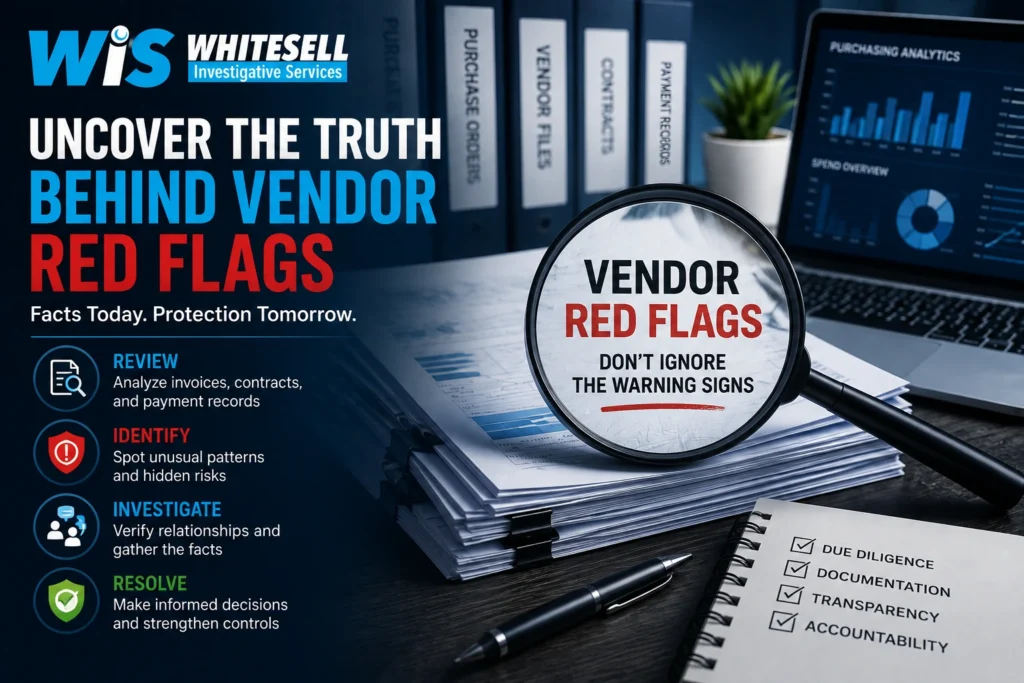
What Are the Most Common Vendor Fraud Schemes?
Vendor fraud can take different forms depending on how a company’s purchasing and payment systems operate.
Some commonly investigated patterns include:
- Fictitious vendors: A vendor account may be created for a company that does not actually provide legitimate goods or services.
- Inflated invoices: A legitimate product or service may be billed at a price that does not match the agreed terms.
- Duplicate billing: The same goods or services may be invoiced more than once.
- Non-delivery: A company may pay for products or services that were never delivered or completed.
- Unauthorized purchases: Orders may be placed outside approved purchasing procedures.
- Kickbacks: An employee may allegedly receive something of value in exchange for favoring a particular vendor.
- Conflicts of interest: A decision-maker may have an undisclosed financial or personal relationship with a supplier.
- Employee-vendor collusion: An employee and outside vendor may work together to manipulate invoices, purchasing records, or payments.
Each situation requires verification. An accounting error, administrative mistake, or legitimate business exception can sometimes resemble suspicious activity.
What Vendor Fraud Red Flags Should Businesses Watch For?
Fraud concerns often begin with a pattern rather than a single obvious event.
A business may notice that one vendor receives an unusually large share of purchases, invoices lack supporting records, or payments repeatedly fall outside normal approval procedures.
Other warning signs may include:
- A recently created vendor receiving significant payments
- Vendor addresses that appear connected to employees
- Unexplained changes to banking or payment information
- Missing purchase orders
- Repeated exceptions to company purchasing policies
- Vendors with incomplete contact or business information
- Payments approved unusually quickly
- Repeated complaints about goods or services that were supposedly provided
- One employee closely controlling a vendor relationship
These issues deserve review, but they should be treated as investigative leads rather than conclusions.
What Suspicious Billing and Invoice Patterns Can Indicate Fraud?
Invoices often provide some of the earliest clues that a vendor relationship should be examined more carefully.
Duplicate or Nearly Identical Invoices
Two invoices may contain the same amount, description, date, or purchase information. In other cases, invoice numbers may be slightly altered while the underlying charge appears identical.
Duplicate invoices can result from an administrative mistake, but recurring duplicates may justify further review.
Unusual Invoice Numbers
Businesses may notice irregular sequences, repeated invoice numbers, or numbering that does not resemble a vendor’s normal billing pattern.
An unusual number by itself proves nothing. It becomes more relevant when combined with other inconsistencies.
Round-Dollar Charges
Frequent invoices containing large, perfectly rounded amounts may deserve attention when the vendor would normally provide detailed or variable billing.
Unexplained Price Increases
A vendor’s pricing may legitimately change. However, repeated increases that do not match contracts, purchase orders, quotes, or approved changes should be documented and reviewed.
Inconsistent Descriptions and Unexpected Fees
Vague descriptions such as “services rendered,” unexpected surcharges, or fees that cannot be matched to supporting documentation can make it difficult to verify what the business actually received.
What Purchasing and Procurement Patterns Should Raise Concerns?
Vendor fraud is not limited to invoices. Purchasing behavior can reveal important patterns as well.
One concern is the repeated use of a single vendor when company procedures ordinarily require competitive quotes or bidding.
Other patterns may include:
- Bypassing normal approvals
- Splitting one large purchase into several smaller transactions
- Repeated “emergency” purchases that avoid standard procedures
- Poor or missing documentation
- Sudden changes from established vendors without explanation
- Purchases inconsistent with normal business needs
- Orders approved after goods or services were supposedly received
- Employees resisting routine vendor reviews
Why Split Purchases Deserve Attention
Some organizations require additional approval when purchases exceed a particular amount.
Breaking one purchase into several smaller transactions may allow someone to remain below that threshold. There can be legitimate reasons for separate orders, so investigators should examine the surrounding circumstances rather than assume intent.
How Can Employee and Vendor Relationships Create Fraud Risks?
A close relationship between an employee and a vendor is not automatically improper. Problems arise when a relationship creates a conflict of interest, affects purchasing decisions, or is deliberately concealed.
Potential concerns may include:
- Undisclosed family or personal connections
- An employee receiving gifts or benefits from a vendor
- Consistent favoritism without a clear business reason
- Resistance to competitive bidding
- One employee selecting the vendor, approving the work, and authorizing payment
- An employee becoming defensive when routine vendor questions are raised
- Vendor contact information overlapping with employee information
These indicators require careful verification.
When the concern appears to involve an employee stealing, diverting company resources, or participating in dishonest transactions, an Internal Theft investigation may provide a more appropriate path for examining the employee-related aspect of the matter.
What Internal Controls Can Help Reveal Vendor Fraud?
Internal controls cannot eliminate every fraud risk, but they can make suspicious activity easier to identify.
Separation of Duties
Whenever practical, the same person should not control every stage of a transaction.
For example, different employees may be responsible for selecting vendors, approving purchases, confirming receipt, and authorizing payment.
Vendor Verification
Businesses can periodically confirm that vendors are legitimate, active, and using verified contact and payment information.
Invoice Matching
Invoices can be compared with purchase orders, contracts, approvals, and receiving records before payment is released.
Regular Reconciliation
Accounting and purchasing records should be reconciled so unexplained discrepancies can be investigated.
Periodic Vendor Reviews
A review of vendor activity may reveal unusual payment volumes, duplicate vendors, unexpected price changes, or purchasing patterns that were difficult to see transaction by transaction.
What Evidence Can a Professional Investigator Collect?
When internal questions cannot be resolved through normal accounting or management review, an investigator may help organize and verify information.
Depending on the circumstances and what can be lawfully obtained, evidence may include:
- Invoices and payment records
- Purchase orders
- Vendor contracts and applications
- Delivery or receiving records
- Business and public records
- Communication records provided for investigation
- Timelines of transactions and events
- Witness or employee interviews
- Connections between individuals and businesses
- Lawful field observations
- Documentation showing recurring patterns
Investigators may compare multiple sources rather than relying on one suspicious invoice or allegation.
Businesses should preserve relevant records when concerns emerge. Employees should also avoid unauthorized access, illegal surveillance, impersonation, wiretapping, or other covert actions that could create additional legal problems.
When Should a Business Escalate Suspected Vendor Fraud?
Not every accounting discrepancy requires an outside investigation. Many can be explained through ordinary reconciliation or a discussion with the vendor.
Escalation may become appropriate when suspicious activity is repeated, substantial, or difficult to explain.
Examples include:
- Significant or continuing financial losses
- Multiple questionable transactions involving the same vendor
- Missing or altered documentation
- Conflicting explanations from employees or vendors
- Evidence suggesting several people may be involved
- Unexplained relationships between employees and suppliers
- Internal reviews that cannot determine what happened
- Concerns that important evidence may disappear
Before taking disciplinary, contractual, or legal action, businesses may also want guidance from appropriate legal, accounting, or financial professionals.
How Can a Corporate Investigation Help Clarify What Happened?
A corporate investigation provides structured, independent fact-finding when a business needs more than suspicion.
The objective is not to begin with the assumption that fraud occurred. Instead, investigators can gather available records, establish timelines, conduct appropriate interviews, identify relationships, and compare information for inconsistencies or recurring patterns.
This process can help management understand what the evidence actually supports.
For situations involving questionable vendors, financial discrepancies, employee misconduct, or other unexplained business activity, Corporate Investigations can provide a broader framework for determining what occurred and documenting relevant findings.
An investigation cannot guarantee that fraud will be proven. It can, however, help replace assumptions with organized information that business leaders and their professional advisers can evaluate.
What Charlotte Businesses Should Know About Investigating Vendor Fraud
Charlotte businesses dealing with suspicious vendor transactions should focus first on preserving records and limiting unnecessary speculation.
Keep relevant invoices, contracts, purchase orders, communications, approval records, payment information, and receiving documentation. Establishing a clear timeline can also help show when the questionable activity began and which individuals or transactions were involved.
Avoid confronting people based solely on assumptions when doing so could affect evidence or complicate an internal review.
Whitesell Investigative Services provides investigative services to businesses in the Charlotte area. Organizations that need independent assistance can use the Charlotte location page to learn more about local service availability.
FAQs
What is an example of vendor fraud?
Vendor fraud may involve a fictitious supplier, duplicate or inflated invoices, payment for goods that were not delivered, unauthorized purchases, kickbacks, or collaboration between an employee and vendor. The facts of each case must be verified before fraud can be established.
How do businesses detect vendor fraud?
Businesses may detect suspicious activity through invoice reviews, reconciliations, vendor verification, purchasing audits, employee reports, or patterns discovered during financial analysis. Irregular activity should be documented and investigated rather than treated automatically as proof.
Are duplicate invoices always fraud?
No. Duplicate invoices can result from administrative mistakes or payment-processing errors. Repeated duplicates, particularly when accompanied by other suspicious patterns, may warrant closer examination.
What records should be reviewed when vendor fraud is suspected?
Relevant records may include invoices, purchase orders, contracts, vendor applications, receiving documents, payment records, approvals, communications, and account changes. Comparing those documents can help identify discrepancies.
What are signs of employee-vendor collusion?
Possible warning signs include undisclosed relationships, unexplained favoritism, resistance to competitive bidding, unusual approval patterns, or one employee exercising excessive control over a vendor relationship. These are indicators to verify, not proof of collusion.
When should suspected vendor fraud be escalated?
Escalation may be appropriate when suspicious transactions recur, financial losses are substantial, records appear missing or altered, several individuals may be involved, or an internal review cannot establish what occurred.
What evidence can an investigator use in a vendor fraud investigation?
Depending on the circumstances, investigators may examine financial and vendor records, public records, communications provided for review, witness interviews, timelines, relationships between parties, and other lawfully obtained information.
Turn Vendor Concerns Into Verifiable Facts
A suspicious invoice or unusual vendor relationship can create serious questions for a business, but acting on assumptions can create problems of its own.
At Whitesell Investigative Services, we help businesses examine concerns through organized, evidence-focused investigations. When vendor activity involves unexplained transactions, possible employee participation, missing records, or patterns that an internal review cannot resolve, independent fact-finding can help clarify the situation.
If your business has identified vendor fraud red flags that deserve a closer look, contact Whitesell Investigative Services to discuss the circumstances and determine whether a corporate investigation is an appropriate next step.