
How Investigators Document Workers’ Compensation Claim Activity
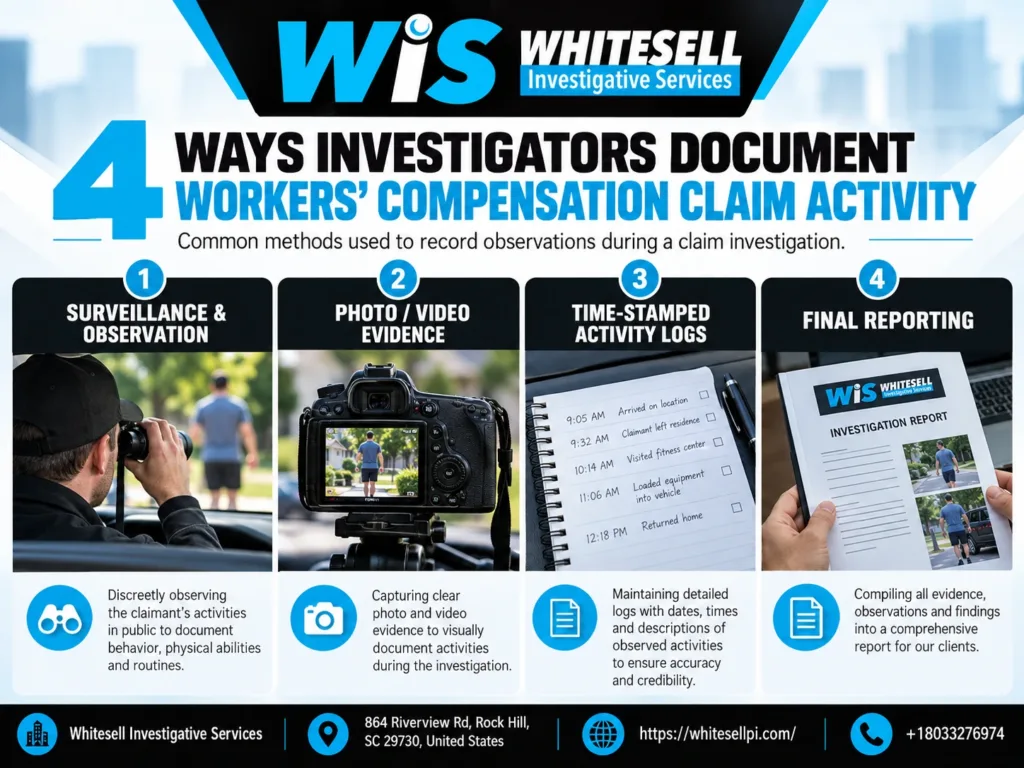
Investigators document workers’ compensation claim activity by lawfully observing relevant behavior, recording when and where it occurs, and preparing objective reports supported by notes, photographs, or video when appropriate. Their role is to establish a reliable factual record, not to decide whether a claimant is injured or whether fraud has occurred.
Careful documentation gives insurers, employers, attorneys, and claims professionals information they can review alongside reported restrictions, medical information, and other claim records. The value comes from accuracy, context, chronology, and impartial reporting rather than conclusions based on isolated observations alone.
What Are Investigators Asked to Verify in Workers’ Compensation Claims?
Workers’ compensation investigators are generally asked to document facts relevant to specific questions about a claim. The assignment may involve determining whether observable activity provides additional information that could assist the professionals reviewing the matter.
An investigator might document a claimant leaving a residence, entering a vehicle, visiting a public location, carrying visible objects, or performing other observable activities. What matters depends on the purpose and authorized scope of the investigation.
Professional investigators should not begin surveillance with the assumption that misconduct has occurred. Their responsibility is to observe and accurately record what happens during the assigned period.
That distinction is important. Seeing a person perform an activity does not, by itself, establish that the person is capable of performing unrestricted work or that a reported injury is false.
Whitesell Investigation Services provides insurance investigation services designed to give clients factual information they can evaluate within the broader context of a claim.
How Is Workers’ Compensation Surveillance Conducted Lawfully?
Workers’ compensation surveillance should be conducted within applicable laws, privacy requirements, and professional investigative standards.
Investigators generally focus on activity that can lawfully be observed from appropriate locations. They must respect reasonable expectations of privacy and avoid entering private property without authorization.
Lawful surveillance also requires professional judgment. An investigator should understand the boundaries of the assignment and avoid intrusive conduct that goes beyond the legitimate investigative purpose.
Rules concerning privacy, recording, access, and investigative activity can vary depending on the circumstances and jurisdiction. For that reason, surveillance should be performed by investigators who understand the legal and professional requirements relevant to their work.
The goal is not aggressive observation. It is lawful, defensible, and accurate documentation.
What Types of Claim Activity Can Be Documented?
Investigators may document observable activities that are relevant to questions raised during claim review.
Depending on the assignment, observations could include walking, entering or exiting vehicles, traveling to public locations, carrying visible items, performing outdoor tasks, or engaging in repeated physical movements.
Duration can also provide useful context. Observing someone perform an activity briefly is different from documenting the same activity repeatedly or for an extended period.
Investigators should describe what they actually observe rather than characterize behavior with subjective language.
For example, a report stating that a person carried an identifiable object from a vehicle to a building provides a factual description. Saying the person “appeared completely healthy” introduces an interpretation that the investigator may not be qualified to make.
Objective language makes documentation more useful to everyone reviewing the claim.
How Investigators Create Time-Stamped Documentation
Chronology is a central part of professional surveillance documentation. Investigators record when relevant observations occur so clients can understand the sequence and duration of documented activity.
A surveillance record may identify the date, time, relevant location, observable activity, changes in activity, and periods when no relevant activity was seen.
Investigators may also note when photographs or video correspond with particular observations.
Why does timing matter?
A clear timeline prevents individual observations from becoming detached from their context.
Consider the difference between stating that someone performed yard work and documenting when the activity began, what was observed, how long the observation continued, and what occurred afterward.
The second description gives the claims professional considerably more information.
Periods without activity can matter as well. A complete chronology should not create the impression that continuous activity occurred when surveillance actually included significant gaps.
How Photos and Video May Support Claim Review
Photographs and video can supplement written observations by preserving visible activity for later review.
Video may help show movement, sequence, duration, or context that would otherwise rely entirely on written descriptions. Photographs can document particular moments relevant to the investigative assignment.
Visual documentation should still be interpreted carefully.
A short recording does not necessarily establish how someone felt during an activity, whether discomfort occurred later, or whether the activity was consistent with a medical restriction.
Investigators therefore should avoid presenting images as proof of conclusions the images cannot independently establish.
The strongest documentation combines visual material with accurate notes explaining when and under what observable circumstances the material was obtained.
How Observed Activity Is Compared With Reported Restrictions
One reason investigators may be retained is to gather factual information that can be reviewed alongside reported physical restrictions or other representations associated with a claim.
The investigator’s role is primarily observational.
Suppose an investigator documents a claimant lifting an object. The report can describe the object, observable movement, time, duration, and surrounding circumstances when those details can be reliably established.
The investigator should not automatically conclude that the activity proves the person has no lifting restriction.
Medical restrictions can involve weight, repetition, duration, pain, recovery time, or other considerations that surveillance alone cannot determine.
Claims professionals, attorneys, medical professionals, and other authorized decision-makers can assess how documented activity relates to the information already contained in the claim.
This separation between observation and conclusion protects the integrity of the investigation.
Why Accurate Notes and Chronology Matter
Accurate notes allow another professional to understand what occurred without depending on the investigator’s memory or assumptions.
Strong documentation is specific.
Instead of writing that a claimant “was active all morning,” an investigator can document individual observations with corresponding times and factual descriptions.
Chronology also helps connect written notes with photographs and video. A reviewer can identify when an event occurred and locate the supporting material associated with that observation.
Consistency matters too. Notes, reports, and visual documentation should not contradict one another.
Investigators should clearly distinguish direct observation from information obtained through another source. They should also avoid filling gaps with assumptions.
A professional report becomes more credible when it acknowledges what was and was not observed.
What Investigators Should Avoid During Surveillance
Investigators should avoid conduct that compromises legality, privacy, objectivity, or the reliability of their findings.
Trespassing, unlawful access, intrusive observation, exaggeration, and unsupported conclusions can undermine an otherwise legitimate investigation.
Investigators should also avoid approaching surveillance as a search for evidence that confirms a predetermined belief.
If surveillance does not reveal activity relevant to the client’s concerns, that result should be documented accurately. Professional investigation is not about producing an unfavorable finding against a claimant.
Selective reporting can also create problems.
A brief moment should not be presented as though it represents hours of continuous behavior. Similarly, an investigator should not describe an activity in stronger terms than the observations or recordings support.
Objective reporting protects the usefulness of the investigation.
How Investigation Reports Support Insurance Claim Review
An investigative report organizes observations into a format that insurers, employers, attorneys, and claims professionals can evaluate.
The report may identify the investigative objective, dates, relevant locations, chronological observations, documented activities, and references to supporting photographs or video.
It may also identify limitations or periods when meaningful observations were not available.
What makes an investigative report useful?
Clarity is more valuable than dramatic language.
A reviewer should be able to understand what investigators observed, when they observed it, and what supporting documentation exists.
Reports should distinguish factual observations from interpretation. They should not diagnose medical conditions or declare that a claimant committed fraud based solely on surveillance.
Instead, investigators provide information that authorized professionals can compare with other claim evidence.
Readers looking for the broader investigative process can review our workers’ compensation fraud investigation guide, which covers the subject beyond surveillance documentation and reporting.
When Is Additional Investigation Appropriate?
Additional investigation may be appropriate when legitimate questions remain after an initial period of surveillance or when new information creates a reasonable need for further documentation.
One surveillance period does not always provide enough information to understand typical activity.
A claimant may remain home during the observation period, weather may limit activity, or circumstances may prevent meaningful observations.
Those results should not automatically trigger continued surveillance.
The decision to conduct additional investigation should depend on the purpose of the claim review, information already available, unresolved questions, and whether further investigation is reasonably justified.
The objective should remain the same: gather useful facts rather than continue surveillance until a desired result appears.
For insurers, attorneys, employers, and claims professionals handling matters in South Carolina, our Columbia investigative services provide a local resource when professional investigative support is needed.
FAQs
Does workers’ compensation surveillance prove fraud?
No. Surveillance documents observable activity. That information may contribute to claim review, but an isolated observation does not automatically establish that an injury is false or that fraud occurred.
What does a workers’ compensation investigator document?
Investigators may record dates, times, relevant locations, observable movements, activities, and other facts within the authorized investigation. Lawfully obtained photographs or video may supplement written notes.
Why are time-stamped surveillance notes important?
Time-stamped notes establish chronology. They help reviewers understand when activity occurred, how observations relate to one another, and how written documentation corresponds with photographs or video.
Can investigators compare surveillance with medical restrictions?
Investigators can document observable behavior that may be relevant to reported restrictions. Medical or claims professionals are generally better positioned to determine whether those observations are medically significant or inconsistent with documented limitations.
What happens when surveillance shows no relevant activity?
Investigators should report the results accurately. Surveillance is intended to document what occurs during the observation period, not guarantee evidence supporting a particular outcome.
Can video tell whether someone is capable of returning to work?
Video can document visible activity, but it cannot necessarily establish pain, endurance, recovery, medical limitations, or overall work capacity. Those questions require broader evaluation than surveillance footage alone can provide.
Clear Documentation Starts With a Defined Investigative Need
When a workers’ compensation claim raises questions that require independent factual documentation, the investigation should begin with a clear objective and remain focused on accurate observation. At Whitesell Investigation Services, we approach insurance investigations with that principle in mind.
We document what can lawfully and objectively be observed, organize relevant activity into a clear chronology, and provide professional reporting for client review. If your organization needs investigative support for a workers’ compensation or insurance matter, we can discuss the questions involved and determine an appropriate investigative scope.
Key Takeaways
Workers’ compensation investigators provide objective documentation that can help authorized professionals evaluate claim activity in context. Effective investigations rely on lawful surveillance, accurate time-stamped notes, factual descriptions, appropriate photographs or video, and reports that separate observation from interpretation. Documented activity should never automatically be treated as proof of fraud or medical capability. Instead, investigators establish a factual record that insurers, attorneys, employers, and claims professionals can review alongside other available evidence. Accurate chronology, professional restraint, and impartial reporting ultimately make investigative findings more useful and credible.